WILLISTOWN CONSERVATION TRUST

  • Facebook
  • Instagram
  • LinkedIn
  • YouTube
DONATE
  • About
    • HOW WE WORK
    • WHERE WE WORK
    • OUR STAFF AND TRUSTEES
    • JOBS & INTERNSHIPS
    • RUSHTON CONSERVATION CENTER
    • STRATEGIC PLAN
    • INCLUSION, ACCESS, AND BELONGING
    • FAQs
  • LATEST
    • BLOG
    • IN THE NEWS
    • PUBLICATIONS
    • PHOTOS
  • EDUCATION
    • GROUP EDUCATION
    • LAND PROTECTION
    • STEWARDSHIP
    • BIRD CONSERVATION
    • COMMUNITY FARM
    • WATERSHED PROTECTION
    • RUSHTON NATURE KEEPERS (RNK)
  • NATURE PRESERVES
    • ASHBRIDGE PRESERVE
    • HARTMAN MEADOW
    • KESTREL HILL PRESERVE
    • KIRKWOOD PRESERVE
    • RUSHTON WOODS PRESERVE
  • EVENTS
    • EVENT CALENDAR
    • BARNS & BBQ
    • RUN-A-MUCK
    • WILDFLOWER WEEK
    • ACCESS Program
  • Support
    • WAYS TO GIVE
    • SPONSOR THE TRUST
    • CORPORATE PARTNERSHIP PROGRAM
    • JOIN THE SYCAMORE SOCIETY
    • LEGACY SOCIETY & PLANNED GIVING
    • VOLUNTEER
    • DELCO GIVES 2026

12.7 More Acres Conserved Forever

November 11, 2019 By Communications Team

The map of permanently conserved land in the Willistown area just got a little greener, thanks to Lawrie Harris. Lawrie donated a Legacy Conservation Easement to the Trust on November 11, 2019, protecting her 12.7 acres on Twinbrook Road from development forever. Located on Twinbrook Road in Easttown Township, in what is known as the Leopard Tract, the gently sloping site is primarily wooded and features a small tributary to Crum Creek named Grubb Mill Run. Several acres of open meadow area surrounds Lawrie’s home and garage, the only structures on the property.

The easement will limit further subdivision of the property and will protect its natural features that serve as important wildlife habitat, support the surrounding ecosystem and contribute to scenic views along Twinbrook Road. The easement defines most of the property as Sensitive Riparian Area, which include wetlands, hydric soils and floodplain, and limits the amount of disturbance allowed in these areas.

Lawrie shares her late husband Jay’s passion for the environment, and wants to conserve the land to ensure it will stay just as it is today, so both people and wildlife can enjoy it forever. Her decision to donate the easement was prompted, in part, by neighbors Kate and Ben Etherington’s recent decision to do the same. We are grateful to Lawrie for her foresight and generosity.

“I want to be absolutely certain that future owners will keep this property intact and take care of the stream and woodland. We don’t have many places like this left and we need to preserve them,” said Lawrie. “And the process of working with the Trust has been easy and enjoyable. Willistown Conservation Trust has a 40-year legacy of protecting land in our area.”

When you look at a the Trust’s protected lands map, you see a mosaic of open space comprising preserved parcels of all sizes – from hundreds of acres to just a few. And in an era when conserving habitat, protecting the quality of our water supply, and offsetting the impact of human activity is so vital, every acre counts.

We developed Legacy Easements, like the one that protects Lawrie’s land, specifically so owners of smaller parcels of land could protect their land in perpetuity. Legacy Easements are generally less complicated than traditional ones and can be tailored to protect features of an owner’s property that are personally and/or environmentally significant.

Thank you Lawrie, another hero of our countryside!

Filed Under: Conservation, Land Protection, Nature, Watershed

Volunteers Plant 300 Trees To Improve Ridley Creek Watershed

October 18, 2019 By Lauren McGrath

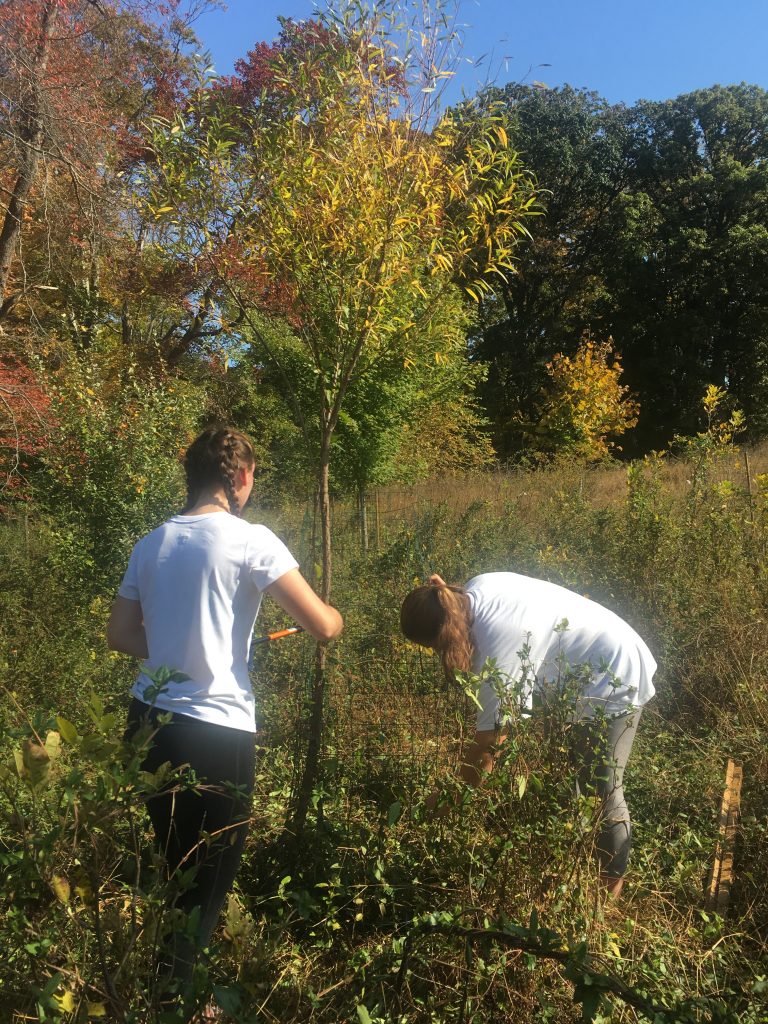
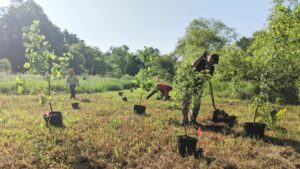
As the sun rose over the meadow that was formerly Ashbridge Lake on October 4, the first of our three days of tree planting, I stood and surveyed the planting area that was soon to be home to 300 trees and shrubs and felt a sense of excitement (and some stress) for the event that was about to take place.  Months of effort and planning had gone into making sure the next three days were to go smoothly.  Now, as I stand at the edge of the meadow and gaze at all of the beautifully planted and caged trees I have only one feeling: gratitude.   I was recently taught my first Lenape word: Wanishi (“Wah-ni’-shee”), which is a profession of gratefulness. Used to start every meeting, it feels appropriate to start this post of appreciation for all of the effort that went into this project.

Thank you to each and every volunteer who came out over the course of the summer to help prepare the planting site –from weedwacking and digging holes,  to planting, caging and watering the trees.  A major thank you to Mother Nature, who was thoughtful enough to break the drought with a gentle rain the day before the planting was due to take place, which made life much easier for the group of hunters who had volunteered to assist yours truly in digging holes for the trees. 

Each planting day was cool, clear, and perfect for all of the labor that took place.  Over 60 incredible volunteers came out over the course of three planting days – families, individual volunteers, friends, coworkers – each day was filled with laugher as friends, old and new, bonded over planting new life into the meadow.  Our fabulous Watershed team was reunited, as past interns and Drexel co-op students returned with friends; enthusiastic freshmen in the Drexel University Biodiversity, Earth and Environmental Sciences (BEES) program came out with their fearless leader and professor Dr. Marie Kurz; a local scout family came to work hard; Tree Tenders from Goshen and elsewhere leant their expertise and guidance. Two teachers from Kennett Square school district came out – neither of which knew the other had signed up!  Rain began to fall as the final cages were being placed around the trees, saving us from hauling buckets of water to our new plants.

We could not have done this vital work without the hard work of every single volunteer. Your effort is helping to improve the habitat both on the stream banks and in the channel.  As the roots of each tree grow into the soil, they will stabilize the sediment and slow the rate of erosion.  Over the coming years, the canopy will spread and begin to shade the stream and keep the water cool.  The impact of each tree will improve the water quality in our watershed, and we are excited to monitor the changes that take place over the next several decades.  Already, I am starting to see an improvement to the ecological value of this meadow (before it was filled with invasive canary reed grass and mile-a-minute vine and inhabited by a stunning number of non-native Chinese praying mantis). In the areas that we have cleared since the spring, we are seeing native sedges begin to appear and an increase of butterflies using the area.  I have been observing the wildlife starting to use the space – birds now move in each morning, hopping from tree to tree and exploring the new habitat.  As the birds learn, so do the deer, but the cages that were placed around the trees by volunteers should help to keep them safe from the curious white tails.

The next time you’re talking a walk through Ashbridge Preserve, please take a moment to pause in the planting site.  I hope you feel the same way I do as you look at trees growing in the meadow. We’re already planning the next round of planting, so please watch for announcements if you want to join us!  Also, take a look at the time lapse video we shot over the tree days.

Of course, none of this would have been possible without the generous funding provided by the Pennsylvania Department of Conservation and Natural Resources and TreeVitalize. A special thank-you goes to REI.  As if the joy of planting trees was not enough, they donated amazing door prizes to raffle off to a lucky volunteer each day! 

Filed Under: Conservation, Nature Preserves, Stewardship, Watershed

Variety is the Essence of Life

October 7, 2019 By Stewardship Team

The old saying goes that variety is the spice of life. In nature, variety is the very essence of life.

Hopefully you’ve read and enjoyed our recent blog posts about the importance of riparian buffers and tips for planting trees and shrubs, if you haven’t yet please take a look. You’ll find helpful guidance, which will be handy for World Planting Day coming up on October 22!

An important aspect of healthy riparian buffer is planting a variety of species, which will help support a variety of insects, animals, bacteria, fungi and other living things. A variety also looks nice, providing different colors and textures in your landscape.

To help you, we’ve assembled a collection of our favorite native trees and shrubs that grow well in riparian buffers.

You can also download a PDF here for future reference.

For detailed information about each of these, you can consult wildflower.org. You can also talk with a reputable native plant nursery or landscape designer about what variety of plants to select for your particular area.

Filed Under: Conservation, Native Plants, Nature, Stewardship, Watershed

Riparian Buffer Planting – Step 3. Preserve

September 20, 2019 By Stewardship Team

The final blog post in our series of 3 is designed to help you plant native trees and shrubs in a riparian buffer (the land that borders streams and other waterways). While we have been focusing on planting in a riparian buffer, most of the tips provided will apply to planting trees or shrubs in other locations on your property.

Once your trees and shrubs are planted, it is important to protect them from deer damage! Placing tree guards or constructing your own fencing (photos below) around individual trees or shrubs is the best way to protect them from deer until they become large enough to survive without protection (typically 8-10 years).

  • Create your own fencing to protect your newly planted tree or shrub. Or…
  • …use commercially-available tree guards. These can be time-savers for large planting projects.

Once installed, periodically check the plants and manually remove any aggressive vines climbing on the tree guards or fencing. Avoid the use of chemicals to fight the vines in riparian zones; they can harm the plants, insects and our waterways.

See our post about the importance of riparian buffers and our first post about preparing to plant and our second post about planting.

Learn how to give your trees and shrubs a strong start by attending one or more of our upcoming tree planting events on May 29, 30 & 31.  More information and volunteer sign up for these upcoming plantings available soon!

Filed Under: Conservation, Native Plants, Nature, Stewardship, Watershed

Riparian Buffer Planting – Step 2. Plant

September 18, 2019 By Stewardship Team

Welcome to the second in a series of 3 blog posts to help you plant native trees and shrubs in a riparian buffer (the land that borders streams and other waterways). Most of the tips provided in these posts also apply to planting trees or shrubs in other locations on your property.
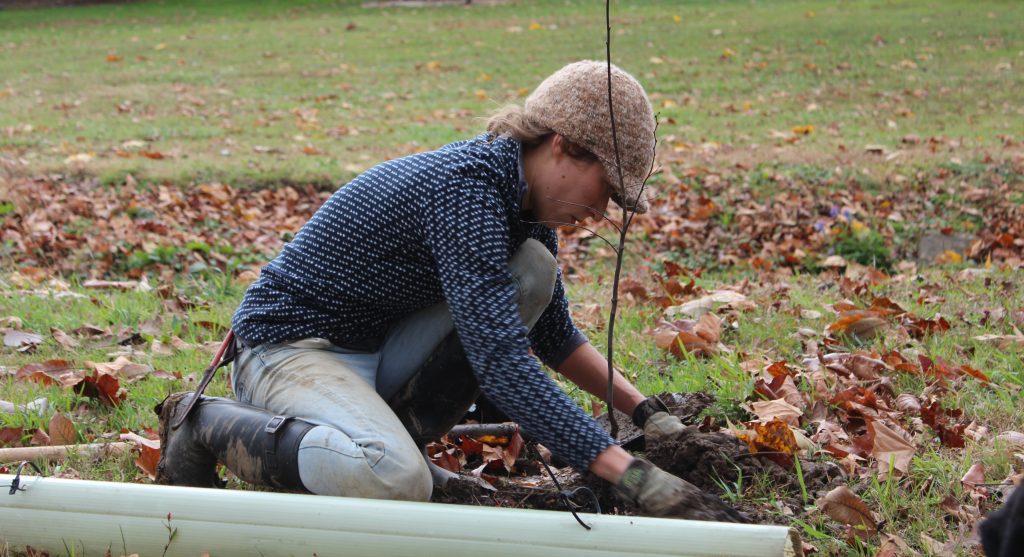
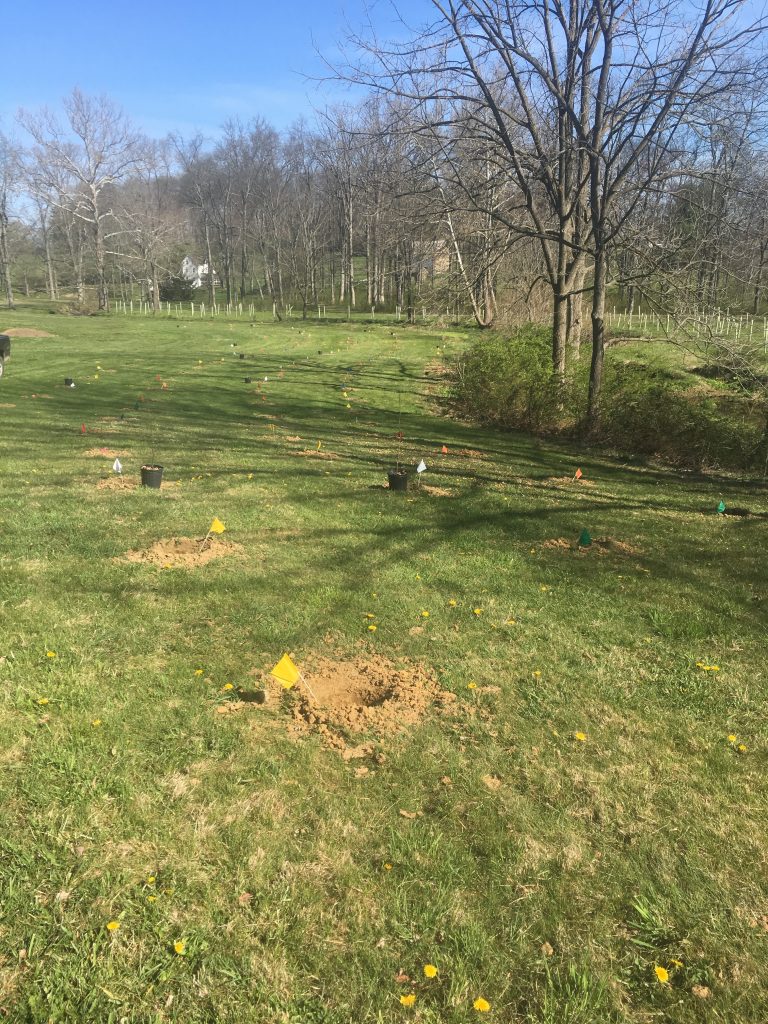
When planting, dig the hole as deep as the pot and twice as wide. Be sure to keep the root flare (where the roots start to spread from the trunk) just above ground level.

Spacing your trees and shrubs approximately 12 – 15′ from each other, you may plant in rows or in more naturalistic groupings to better echo the more organic patterns found in nature – or a combination of both. Get creative!

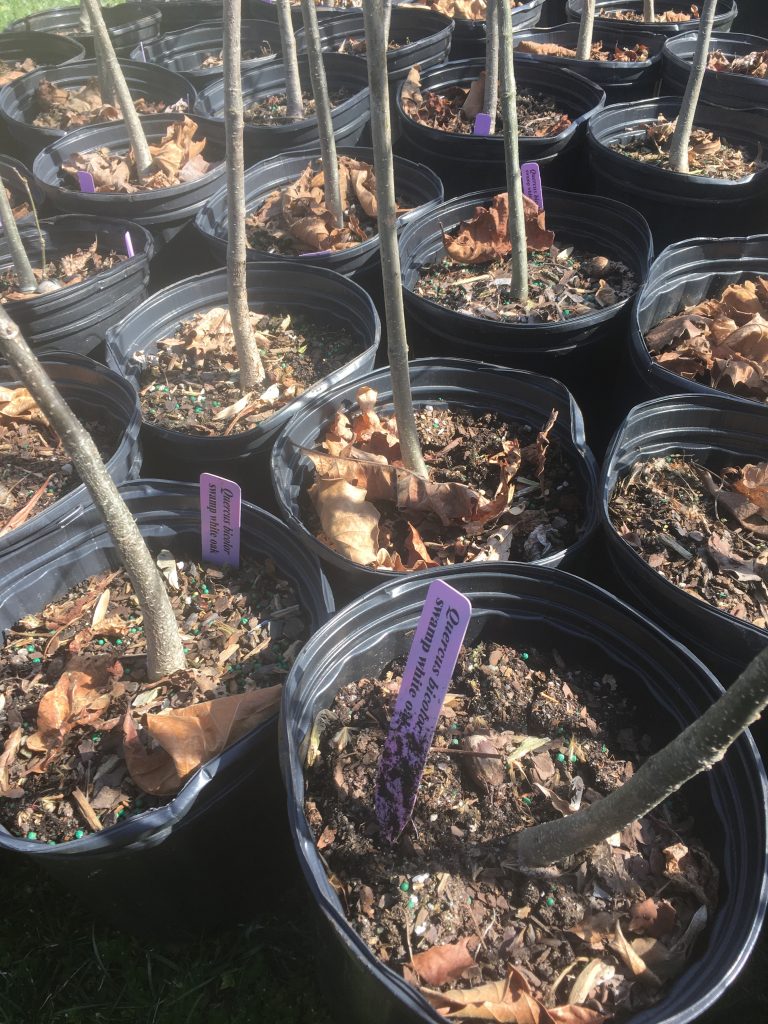
Many of your trees and shrubs will likely arrive in pots. Dig the holes as deep as the pot and twice as wide. Remove the plant from the pot and loosen the roots, especially if they are tightly bound. Adjust your plant in the hole, adding or removing soil as needed so the root flare (where the roots start to spread from the trunk – see photo below) is just above ground level. Take care not to bury  the plant too deep or cover the trunk with soil, while making sure your plant isn’t sitting too high, with its top roots exposed. Tamp the soil around the root ball as you fill the hole to ensure that the plant is firmly planted.
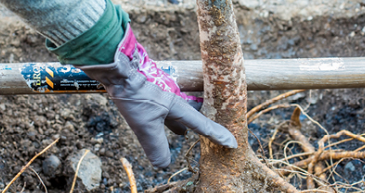
A TreeTenders instructor with the Pennsylvania Horticultural Society points out root flare on a young tree. Photo by PHS.

See our post about the importance of riparian buffers and our first post about preparing to plant.

You can gain some practical planting experience by joining us for a one or more of our native tree planting days – May 29, 30 & 31 – at Ashbridge Preserve. More information and volunteer sign up for these upcoming plantings available soon!
Filed Under: Conservation, Native Plants, Nature, Stewardship, Watershed

  • « Previous Page
  • 1
  • …
  • 10
  • 11
  • 12
  • 13
  • 14
  • Next Page »

CONTACT

925 Providence Road
Newtown Square, PA 19073
(610) 353-2562
land@wctrust.org

501(c)(3) EIN 23-2841453

JOIN OUR MAILING LIST

Copyright © 2026 · WCTRUST.ORG