WILLISTOWN CONSERVATION TRUST

  • Facebook
  • Instagram
  • LinkedIn
  • YouTube
DONATE
  • About
    • HOW WE WORK
    • WHERE WE WORK
    • OUR STAFF AND TRUSTEES
    • JOBS & INTERNSHIPS
    • RUSHTON CONSERVATION CENTER
    • STRATEGIC PLAN
    • INCLUSION, ACCESS, AND BELONGING
    • FAQs
  • LATEST
    • BLOG
    • IN THE NEWS
    • PUBLICATIONS
    • PHOTOS
  • EDUCATION
    • GROUP EDUCATION
    • LAND PROTECTION
    • STEWARDSHIP
    • BIRD CONSERVATION
    • COMMUNITY FARM
    • WATERSHED PROTECTION
    • ECOCENTRIC EXPERIENCE
    • RUSHTON NATURE KEEPERS (RNK)
  • NATURE PRESERVES
    • ASHBRIDGE PRESERVE
    • HARTMAN MEADOW
    • KESTREL HILL PRESERVE
    • KIRKWOOD PRESERVE
    • RUSHTON WOODS PRESERVE
  • EVENTS
    • EVENT CALENDAR
    • BARNS & BBQ
    • RUN-A-MUCK
    • WILDFLOWER WEEK
    • ACCESS Program
  • Support
    • WAYS TO GIVE
    • SPONSOR THE TRUST
    • CORPORATE PARTNERSHIP PROGRAM
    • JOIN THE SYCAMORE SOCIETY
    • LEGACY SOCIETY & PLANNED GIVING
    • VOLUNTEER
    • DELCO GIVES 2026
  • OUR NEWEST PRESERVE
    • OUR NEWEST PRESERVE- KESTREL HILL

Reducing Single-Use Plastics | What You Can Do to Help

July 14, 2022 By CommIntern

By Outreach & Communications Intern Niya Moss
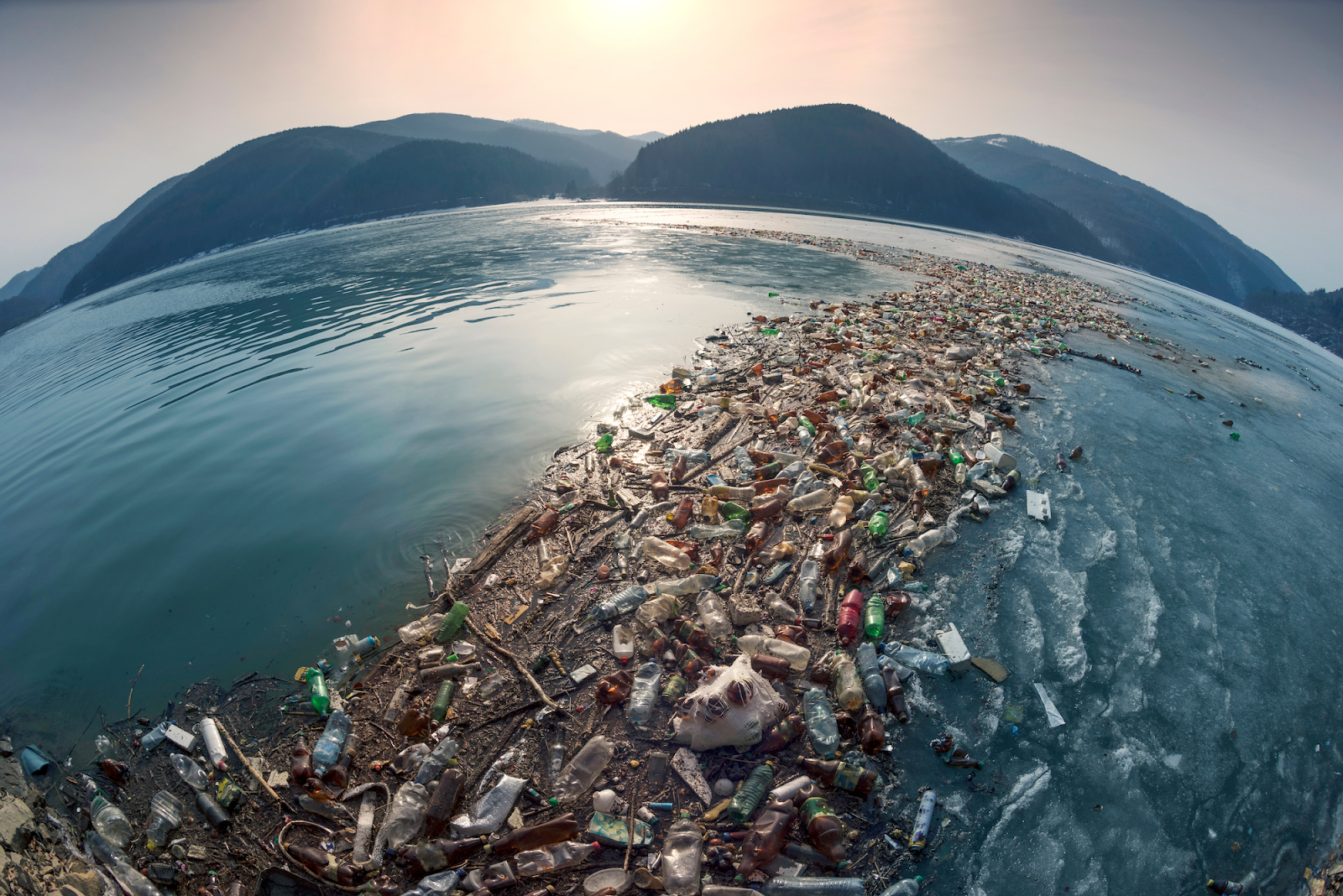
Cover Photo by Jennifer Mathes

Most people find single-use plastics simple and convenient, but there are alternative, more sustainable options that benefit both humans and the environment. Using these alternatives to single-use plastic will benefit all living beings by reducing the negative impacts on the environment.

Animals are not the only creatures threatened by plastic pollution — humans are, as well. While larger plastic materials are killing aquatic animals, minuscule plastic particles, or microplastics, infect our waterways. As a result, these microscopic plastic particles can easily be consumed by humans since they can travel into our tap water systems. Heavy consumption of these particles can result in serious health issues if left untreated. So how can we avoid endangering lives, including our own? Consider reducing the plastic you use with daily alternatives, including reusable grocery bags and bioplastics.

Reusable Grocery Bags


Reducing our plastic use starts with changing our habits; it’s time to make the switch from plastic bags to reusable bags for grocery shopping. Reusable bags are incredibly convenient and do everything a plastic bag can do without the negative impact on the environment. Reusable bags are developed from sustainable, or recycled, materials and are designed to be used multiple times. When people receive plastic bags from grocery stores, they are likely to throw them out once they’ve put their groceries away. Every year, Americans throw away nearly 1 billion single-use plastic bags after bringing them home. We need to find ways to bring this number down.

In addition to the environmental benefits of reusable bags, they are also more cost effective than plastic bags considering most states are now charging their customers for plastic bags. Rather than getting charged multiple times for several plastic bags, you will only have to buy a reusable bag once and continue using it for as long as it stays in good condition. 

Of course, these reusable bags will get worn out over time, but they are much stronger and more durable than plastic bags, and they can be mended to prolong their durability. Without the need to throw out reusable bags after every use, you are already helping to reduce the use of plastic bags and its threat to our environment. The issues plastic pollution has created over the years are only going to get worse and worse. It’s time to put down that plastic bottle and start using alternatives. It may appear to be inconvenient but it’s for the best. Inconvenience is temporary, but damage to the environment can last for lifetimes.

Biodegradable Plant-Based Plastics

Using biodegradable plant-based plastics, or bioplastics, instead of single-use plastics is safer for the environment. When plastic material is described as biodegradable, it simply means that the plastic can be completely broken down into carbon dioxide, water and compost. Plastic material being biodegradable also implies that the material can decompose within weeks or months. Otherwise, the material is viewed as durable, or material that does not biodegrade as quickly.

So what exactly are biodegradable materials? Bioplastics are made from sugars that are grown from algae or crops. The sugars found in the plants are then converted into plastics. Bioplastics are mainly used in packaging, phone casings, straws, bottles, and medical implants. Using bioplastics will not exactly guarantee that the plastics issues will dissipate, but it does give a helping hand in the reduction of the use of single-use plastics.


Additionally, bioplastics are actually less toxic than single-use plastics, and they are cheaper than normal plastics. What most people are unaware of is the multitude of chemicals that are present within plastics. Plastic products contain chemical additives that can pose serious threats towards an individual’s health.

In addition, using bioplastics will reduce the demand for fossil fuels — such as coal — used to make conventional plastics. Doing so will leave a significantly smaller carbon footprint than normal plastics. As the demand for plastic increases, coal combustion increases to keep up with production. Coal combustion is one of the highest sources of mercury pollution in the ocean. As coal is burned, mercury makes its way into the atmosphere before being washed into the ocean. As this cycle continues, the ocean pollution only worsens. Using more bioplastics would reduce the use of coal combustion thus reducing the amount of carbon dioxide, and other greenhouse gasses, emitted into the atmosphere.

As for how to use biodegradable plastics, here are the basics: biodegradable material cannot be recycled. Now, if you are unsure about your item being biodegradable or not, look for the symbol shown here.

​​ 

Not to be confused with the symbol for recycling, which is a group of three arrows in the shape of a triangle. To properly dispose of biodegradable items, they can simply be thrown into the garbage. Because these items are biodegradable, they will naturally decompose without causing harm to the environment. Another option would be to send your items to a recycling facility that specializes in biodegradable materials.

We all live in and share this environment, which means we all need to do our part in reducing the need for single-use plastics. It will not be easy but with enough time and hard work, we can make the environment better for all living beings to thrive.

— By Outreach & Communications Intern Niya Moss

Filed Under: Education, Plastic Free July

Save the Humans! | The Dangers of Plastic Pollution

July 13, 2022 By CommIntern

By Outreach & Communications Intern Niya Moss

When people think of plastic pollution, their first thought is usually “save the sea turtles!” But sea turtles aren’t the only creatures that need saving. The problem is that many individuals refuse to acknowledge plastic pollution because they believe we as humans will not be affected by it. This article will highlight the fact that humans are easily affected by plastic pollution often in subtle and invisible ways. 

Before we begin, it’s important to understand that plastic pollution revolves around microplastics. Microplastics are minuscule plastic particles that have resulted from the decomposition of waste and consumer products. These particles are often present in our water, our soil, and the air we breathe, and they greatly impact our way of life.

Microplastics in our Waterways

Many are aware that there is an abundance of plastic waste polluting our oceans but choose not to acknowledge it because they believe that this will not have an impact on their lives. That is certainly not the case. Plastic materials are typically treated with different types of chemicals or substances such as flame retardants. As these materials start to decompose in the ocean, they become small particles which contain hazardous chemicals. While these particles may be small, they can cause a great amount of damage to the human body.

Microplastic particles can easily be consumed by humans whether it be through the consumption of seafood, or through drinking contaminated water. Microplastics can enter our drinking water through a number of ways, such as doing laundry. When our clothes are being washed, microfibers become loose and are then released as wastewater. It’s worth mentioning that the plastic pollution in the ocean is mainly composed of microfibers and microplastics. The wastewater typically makes its way into our drinking water by means of the sewer systems.

These particles are very toxic because of the chemical additives they contain. Due to their small size, fish unknowingly ingest these particles, and those same fish are later consumed by humans. Consuming these fish poses a threat to human health. The chemicals within the microplastic particles are typically associated with serious health problems like infertility, ADHD and hormone-related cancers. The risks of consuming these chemicals are dangerous and can be fatal.

Plastic Pollution Threatens the Air We Breathe

If you think you’re still immune to the dangers of plastic pollution because you don’t eat fish, think again! Because plastic particles are often microscopic, they can easily be transported through the air by being blown about in the wind. Inhaling these tiny fragments of plastic can no doubt damage your respiratory system. But it gets worse than that – plastic pollution has been known to be a heavy contributor to air pollution. This is a result of burning plastic materials.

When plastics are burned, a chemical reaction occurs where toxic fumes are released into our atmosphere. Such toxic fumes include mercury, furans, and dioxins. Breathing in these fumes can cause severe health issues that can directly impact a person’s respiratory system. The fumes can aggravate any present respiratory issues such as asthma or emphysema. Pregnant women are especially at risk because inhaling these fumes can damage their fertility, or cause neonatal issues. You could be a very healthy and active person with a strong immune system, but that will not protect you from the health risks of breathing in toxic fumes. Air pollution is an issue for all living beings and the burning of plastic materials is only making it worse. If you’re still not convinced about how dangerous plastic pollution is, keep reading!

Microplastics in Soil 

Microplastics aren’t just in the water we drink or the air we breathe – they’re in our soil, too! Microplastics can easily enter agricultural lands through sewer systems, or sewage sludge, to be more specific. Sewage sludge can be described as the solids that are filtered out of the wastewater. Sewage sludge is commonly used by farmers to fertilize agricultural fields. 
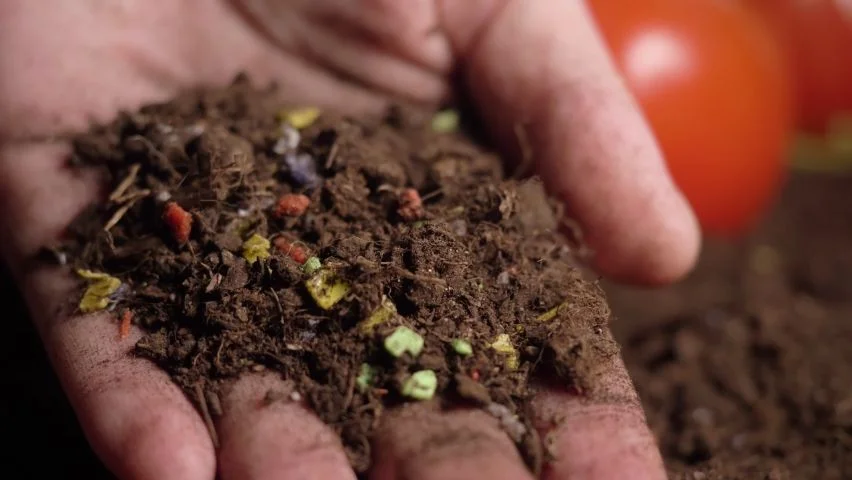
The presence of microplastics in farm soil can be problematic for both humans and the environment. One of those problems being the possibility of microplastics carrying organisms that hold serious diseases that can affect humans and the environment itself. Regarding the environment, the disease-carrying microplastics can affect the soil functions and health of soil fauna. Soil fauna are beneficial organisms that inhabit the soil such as earthworms, mites, nematodes and protozoans. 

Soil fauna play a vital role in keeping our soil rich and full of nutrients. In fact, soil fauna are very crucial in relation to plant growth, litter decomposition, and soil formation. When soil fauna  ingest microplastics, the particles induce toxic effects upon the body systems of the fauna, killing them. Without these microorganisms, our soil will no longer be able to support any crops or plant life. 

The reality is that all of us are affected by plastic pollution, whether we can see it or not. With recent research indicating that microplastics are now making their way into our lungs and blood, we can no longer ignore this very real problem that affects the very things upon which life depends: air, water and soil. It’s time to save the humans before it’s too late.

— By Outreach & Communications Intern Niya Moss
Filed Under: Education, Plastic Free July

Plastic Free July Local Lessons: How Malvern Buttery Reduces Their Plastic Use

July 11, 2022 By CommIntern

Introduction

During this year’s Plastic Free July, the Trust is committing to going plastic free and highlighting tips and tricks to reduce plastic use. Saying no to plastic doesn’t just start at home, it’s a goal that all organizations — and not just environmental groups — can strive for! And one of our favorite local organizations that we are inspired by is Malvern Buttery.

Malvern Buttery is a European-style bakery cafe that aims to highlight the importance of craftsmanship in the food industry while providing a welcoming atmosphere for our community to find a second home in. Explains Joli Ridenour, “We specialize in naturally leavened breads, viennoiserie among other classic pastries, and using locally sourced ingredients to create outrageous breakfast and lunches.”

Read below to find out how this delicious place achieved their goal to minimize plastic use!

When did Malvern Buttery first consider reducing their plastic use?

Since we opened our doors, The Buttery has always strived to keep sustainability at the forefront of our collective minds. We knew right away that we wanted to offer more compostable paper options instead of plastic that takes hundreds of years to breakdown.

What was the reason/inspiration for this decision to reduce your plastic use?

From the food we eat to the air we breathe, our environment is paramount to our communities’ survival and should be embedded in how we go about our day. Plastic takes over hundreds of years to break down, gets in our water systems, destroys ecosystems, and isn’t sustainable for our future. Having a sustainability mindset feels like the right and necessary thing to do as we grow as a business.  

In what specific ways/areas did you reduce your plastic use? And why did you choose these specific areas? Please share examples and photos if you have any!

Once Covid hit the world, we had to make changes to our set up which no longer could include dine in options. It was a no-brainer for us to continue purchasing USDA certified bio-based products like paper straws, compostable sugarcane containers or biodegradable, plant starch based to-go silverware to help leave a smaller footprint.

How long did it take you to implement this change in your business?

Not a ton of time, considering we already were focusing on purchasing “greener” to-go items, but now we needed to buy them in much larger quantities.

What was the biggest challenge that you faced during this process?

The biggest challenge was definitely with the supply chain. 2020 changed so many facets about everything, and we weren’t always able to order the products we knew and trusted in the quantities we now needed.

Did you learn anything surprising during or after making this change?

People notice and want to support a business that makes a concerted effort to be environmentally friendly. While we always leaned towards sustainability, we enjoyed seeing the younger generations being more mindful of these choices and actions as well.

How have customers received this change? Have you had any feedback?

They love it! Our guests have always supported our greener mindset, so it was a natural progression for us to continue sourcing as sustainable as possible. We’re by no means perfect, but when we use plastic, like for our to-go cups, we aim to source it from recycled materials when we can and are always considering alternatives.

Do you intend to continue reducing your plastic use, and if so, do you have any specific goals that you’re working toward that you can share with us?

Definitely! We’re looking for ways we can continue improving. Right now, we’re working on incorporating more glass jars as storage or for selling retail items instead of plastic containers.

Why do you think other businesses should consider reducing their plastic use?

The future is hinged on businesses leading in a more sustainable way, including but definitely not limited to reducing plastic. It’s our responsibility to the community and to the generations that come after us to do our part and take care of all that we put out to the world.

Do you have any advice or resources to share with other businesses or organizations looking to reduce their plastic use?

Research what option is best for your company and always work towards improving that. When we knew we had to bring in to-go silverware, it was important to know the differences between which items would need specific environments to break down properly and then make an informed decision as to what would be best for us right now.

Is there anything else you would like to share?

Our team is full of people that care — not only about the craftsmanship that goes into our food production, but also how we can impact the world around us on an environmental level. We wouldn’t be as successful in our pursuits without the support and input from our internal community — our amazing team.

You can find Malvern Buttery on Instagram @malvernbuttery, online at www.malvernbuttery.com, and at their address: 233 E. King St., Malvern, PA

Keep an eye on our Event calendar for an upcoming Field To Feast featuring Malvern Buttery’s delicious food!

Filed Under: Education Tagged With: Plastic Free July

Plastic Free July 2022: Will You Join the Challenge?

July 1, 2022 By CommIntern

During the last couple of years, and especially during the heights of the pandemic, we have witnessed a drastic increase in single-use plastic; our coveted hand sanitizer comes in plastic bottles of all sizes, plastic containers of disposable wipes are common-place, we have been ordering more takeout meals that arrive on our doorsteps in plastic bowls and bags, and some of our food at the grocery store has sprouted protective plastic coverings.

Some of these plastic habits are dissipating as we return to a state that resembles something closer to “normal,” but the reality is that plastics, and most notably single-use plastics, are still entrenched in our daily lives. As the name suggests, single-use plastics are only used once before they are discarded and examples include straws, plastic sandwich bags, plastic cutlery and Styrofoam to name a few. To make matters worse, our recycling systems are broken; according to the EPA, less than 10% of plastics are recycled, so even if you do the right thing by cleaning and tossing that plastic cup into a recycling bin, it is unlikely that it actually gets processed. Additionally, microplastics continue to end up in our waterways, affecting local watersheds, land, and birds around the world, and as recent research suggests, even making their way into our bodies.

Feeling overwhelmed yet? You are not alone! Our society is dependent on plastic, but you don’t have to be. This month, consider joining the hundreds of millions of participants — including Willistown Conservation Trust — across the world who will be taking the challenge to live a plastic-free lifestyle for all 31 days in July! Plastic Free July is “a global movement that helps millions of people be part of the solution to plastic pollution — so we can have cleaner streets, oceans, and beautiful communities.”

The Plastic Free Foundation has put forth this challenge over the last 12 years, and they’ll walk you through all sorts of tips and resources to aid you on your plastic-free journey, whether you’re looking to eradicate single-use plastic waste at home, work, school, your local café or all of the above. You can start small by bringing your reusable grocery bags and favorite water bottle everywhere you go, or go big by engaging with local businesses and your community to commit to doing better together. You may even surprise yourself as you continue the challenge into August and beyond.

Be sure to sign up for the challenge at plasticfreejuly.org, and join WCT here and on social media (@wctrust) to learn how you can commit yourself to Plastic Free July! We’ll walk you through the basics of discerning what can and cannot be recycled, we’ll cover the the latest research on microplastics, and we’ll share tips and tricks about reducing plastic use from other members of our community.

Filed Under: Uncategorized

Step Back in Time with Owen McGoldrick

May 24, 2022 By CommIntern

All photos are currently on display and for sale in the Rushton Conservation Center, May 17 – August 28.

INTRODUCTION BY OWEN MCGOLDRICK

The color photographs were made using a 4×5” Linhof view camera. Notch and clip marks are shown to emphasize a bygone era, which involved carrying a heavy view camera and tripod, loaded with Kodak or Fuji film, and taking a picture somewhere on the grounds of what is now part of the Kirkwood Preserve, or in the very accommodating and voluminous interior of our mid-19th century farmhouse and barn.

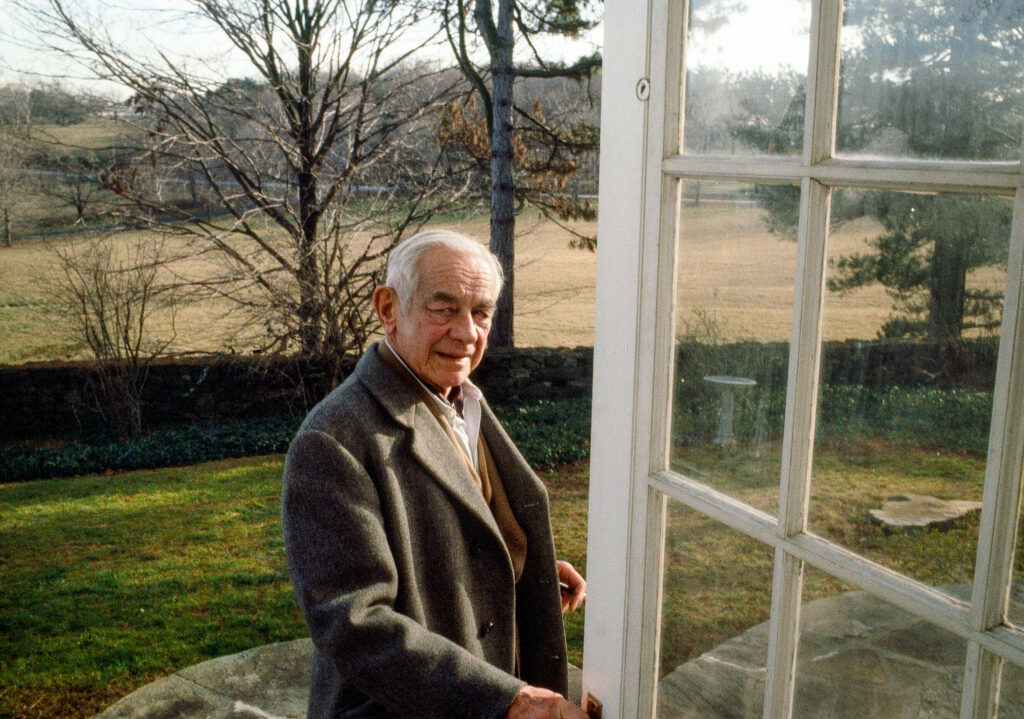
Dr. S.H. overlooks Grubbs Mill and Goshen Roads

“Silo Cap” was one of the very first photos shot with a 35mm Pentax for a beginning photography class at the Columbus College of Art, Ohio. Our family lived in the lower house of Massey Farm (always referred to as White Horse Farm by our clan) from 1963 to 1990. The photographs in this exhibit depict the house, barn and fields that surrounded the fence line.

The landowner, Dr. Robert Strausz-Hupé, lived in the mansion at the top of the hill. He was an Austrian immigrant with Old World ways, a plume of cigarette smoke and cravat. He served as a statesman, professor at Penn and a term as the US ambassador to NATO, as well as Turkey, Sweden and Sri Lanka.  Dr. S. H. could be stern, especially when it came to our lawn mowing abilities, or lack thereof; however, he was also generous, allowing us to use his glamorous swimming pool every summer day from 5 to 6 pm. What a relief it was to jump into that cool water on a hot, muggy summer afternoon. The pool was surrounded on three sides by apple trees which offered useful content for two of the pictures in this exhibit, not to mention homemade applesauce.

Here’s a tidbit. Mrs. Strausz-Hupé once called my mother and asked frantically if we had a car to pick up Dr. S. H. and a military general at the Philadelphia airport. Being the only resource available, off I went to pick up the good doctor and General Alexander Haig in the family VW. As a longhaired 16 year old with limited driving experience, it was a bit soon to be chauffeuring major political figures of national importance. After I dropped them off, mom asked me what they talked about. I replied, “Mostly themselves.”

Tidbit #2. Dr. Strausz-Hupé had an aesthetic streak. He was the first person to turn me on to the 18th century British artist and poet, William Blake. There we sat in his study with little hippie me looking at color plates of this visionary artist. Blake is still one of my favorite historical figures, and not only visually, but the whole daring philosophy of his creative universe is something to behold.

Growing up on a farm with a big barn to play in, acres of fields and woods to explore, and Crum Creek to swim and fish in, was more than a fair deal for any childhood. How remarkable it is that those fields and creek are today’s Kirkwood Preserve! Deep appreciation and a little awe goes to Bonnie Van Alen, Kate Etherington, Willistown Conservation Trust and the active group of local citizens for taking action and saving the day.

The select group of images were recently scanned and retouched in Lightroom and Photoshop and printed within the last two months on Epson Premium inkjet and Kodak professional paper. This is known as “straight photography,” where all effects happened on site and outside the camera, without machinations in Photoshop to create the visual results. The transparencies came out of a 40-year hibernation in carefully stored boxes through many a move, and now my old friends have returned.

GALLERY DESCRIPTIONS

All gallery photos are on display and for sale at the Rushton Conservation Center, May 17 – August 28.

1. The Barn is a Camera | A window shines a sunbeam inside the west storage room, or hay mow.

cam·er·a ob·scu·ra : a darkened box with a convex lens or aperture for projecting the image of an external object onto a screen inside. ORIGIN early 18th century: from Latin, ‘dark chamber.’

2.  Silo Cap | One of the earliest photos from the first year of photography at the Columbus College of Art and Design. I wished I’d thoroughly documented the silo since we have so few photos of it. It was demolished later that year in 1977, after being deemed an unsafe structure.

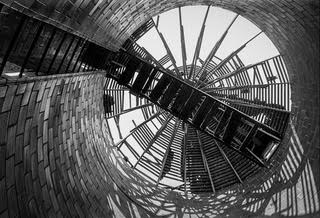
3. Inside Looking Up | Inside the silo looking up at the deteriorating rooftop. A worker would have stood on those steps and lifted the sileage from the outside on an “elevator,” which was actually no more than an iron bucket. Dangerous work.

4. Black and Light | The result of a photography assignment using Dektol as a developer for B&W film. Or was it M-D3? It gives a grainy, high contrast look to the print. I took two negatives and sandwiched them. The barn’s a camera, a playground, a studio, a subject, an object.

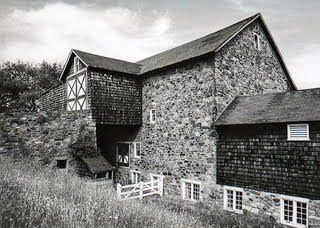
5. Northwest Side | I took this snapshot in the mid-1990’s. Those doors are usually called “X-braced” and lead into the upper threshing room. The double decker barn traces back to English antecedents. A recent shot of one of the storage rooms is shown below.

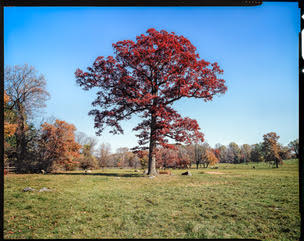
6. The Exemplar | I remember floating by that oak tree in a great flood in June, 1968. There was a continuous wave at the bottom of Barr road.
Crum Creek was flowing to the right of this tree at about a 5-foot depth, a moving lake 10 times its normal size. That’s when I went for a swim and my friend Tom thought I was drowning so he made Boy Scout signals on the edge of the field. You can still see the high water mark from that storm event, put there by the township on telephone poles.

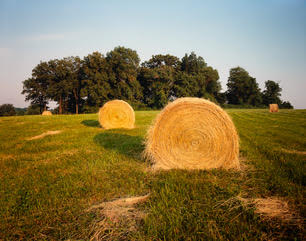
 7. Pennsylvania Landscape | “Tootsie Roll” bales somewhere on Davis Road looking south. Archetypical Pennsylvania farmland nostalgia. For some reason, I think of the Civil War when I look at this print.

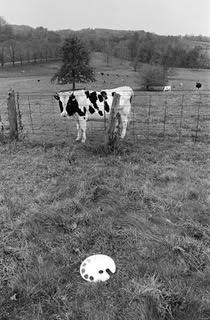
8. Cow Palette | Living amongst the Holsteins brought up mischievous thoughts of the black and white tonal scale in photography. But I didn’t expect the cow to be waiting for me on top of the hill. Hello Ansel Adams Zone System. That’s Crum Creek in the far ridgeline.

9. Speed of Light | From the third floor west bedroom looking into Wyeth country.

10.  A Single Excellent Night | The title comes from the name of an ancient Buddhist text. That’s a 35mm slide projected from a Kodak projector of a TV still shot (was it a Magritte documentary?) into the far room. I painted the walls yellow and asked a friend to pose with an umbrella. She put on my bowler hat. I wish I still had that bowler hat.

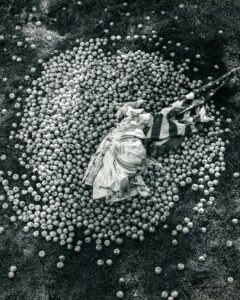
11. Flag Composition | Still life arrangement courtesy of the Strausz-Hupé apple grove. The antique dress was courtesy of mom’s shop in Berwyn. It was a lot of work to get those apples into our enclosed yard in cosmic order. The flag was a family heirloom from family ancestor and WWI flying ace, George Evans. One time I showed the photograph to the father of a very good friend who exclaimed, shocked and angry, “But that’s desecrating the flag!” (The flag should never touch the ground, let alone decaying apples.) You can’t predict some people’s reactions. But I got his point.

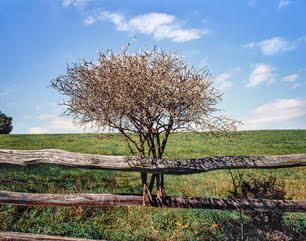
12. Thornley Bush III | I found this natural oddity and stuck it between barbed wire and a fence rail just outside of the mudroom. One time the field behind caught fire from an unmonitored rubbish burn and the fire department had to be called out to douse the flames. The next year the field grass grew back very, very green and healthy. Sometimes calamity brings an improvement.

13. Still Life with Moonrise | A Kodak projector beams a slide of the moon in the third floor bathroom. I was big into projecting slides into interiors and exteriors, and then photographing the on-the-site collage with a view camera. That’s called analog. Ya dig?

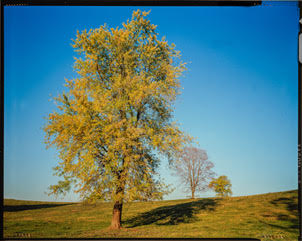
14. Three Tree Hill | A saddle sloped hill that was great for tobogganing. Brought to you by billions of years of tertiary history and a 4×5 view camera. Somewhere near those trees I remember there was a salt block for cows. After some research, sodium in the salt helps with the absorption of calcium and helps to avoid “grass tetany.” I tried licking that maroon colored block once as a kid and never did get grass tetany after that.

15. Priest at Crum Creek 

Crum Creek. I wonder what the Lenni-Lenapes called it?

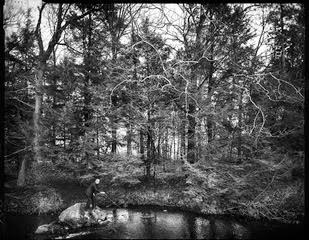
This is a shot of Father Dinda launching a toy boat. He was a real fun character who used to come into my mother’s antique shop in Berwyn. Mom would always have some interesting items in the shop and that’s how I came to borrow the boat.  I love Father Dinda’s self-satisfied grin – a man of the cloth comfortable in his…cloth. How I got him on that rock I’ll never know.

We used to go swimming in one spot called the Sheep hole, where the creek was six feet deep. There was a rope swing on a pine tree, and swing we did into beautiful Crum Creek. I would get a stick and put a piece of bacon on a hook and fish from a large rock. In those summer days in the 60’s, I’d often see rainbow trout, which was always tantalizing because not once did I ever catch a trout with bacon. They don’t go for worms either. I’d inevitably catch a sunfish. This was Huck Finn style fishin’. One time I took my catch home and put him in our aquarium. We called him/ her, Sunny, he/she lasted all summer.

Right across from the big rock where I always sat, there was, and thankfully still is, a magnificent oak tree. Around the time I took Father Dinda’s picture, I set up the view camera in front of a tree in all its autumnal glory, The Exemplar.

16. Portrait of Father Dinda

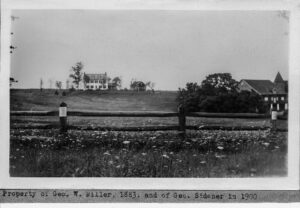
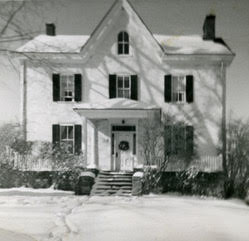
17. White Horse Farm, 1900 | The house on the hill is the mansion where the Strausz-Hupé family lived.

From the Chester County Historical Society Archives.

18. The Lion in Winter | The home had a great fireplace. An excellent home for the holidays.

19. Beatle John | My brother John Pancoast posing in front of the apple cosmos in Alfie’s yard. It could have been a great album cover. John used to go to parties and tell everyone he was George Thorogood’s brother. It worked.

20. First Polaroid: Forebay | A copy of the very first Polaroid trying out a new view camera in 1981. Perspective issues!

Filed Under: Conservation, Education, Film, Land Protection, Nature Preserves, Photography

  • « Previous Page
  • 1
  • 2
  • 3
  • 4
  • …
  • 6
  • Next Page »

CONTACT

925 Providence Road
Newtown Square, PA 19073
(610) 353-2562
land@wctrust.org

501(c)(3) EIN 23-2841453

JOIN OUR MAILING LIST

Copyright © 2026 · WCTRUST.ORG