WILLISTOWN CONSERVATION TRUST

  • Facebook
  • Instagram
  • LinkedIn
  • YouTube
DONATE
  • About
    • HOW WE WORK
    • WHERE WE WORK
    • OUR STAFF AND TRUSTEES
    • JOBS & INTERNSHIPS
    • RUSHTON CONSERVATION CENTER
    • STRATEGIC PLAN
    • INCLUSION, ACCESS, AND BELONGING
    • FAQs
  • LATEST
    • BLOG
    • IN THE NEWS
    • PUBLICATIONS
    • PHOTOS
  • EDUCATION
    • GROUPS
    • LAND PROTECTION
    • STEWARDSHIP
    • BIRD CONSERVATION
    • COMMUNITY FARM
    • WATERSHED PROTECTION
    • ECOCENTRIC EXPERIENCE
    • RUSHTON NATURE KEEPERS (RNK)
  • NATURE PRESERVES
    • ASHBRIDGE PRESERVE
    • HARTMAN MEADOW
    • KESTREL HILL PRESERVE
    • KIRKWOOD PRESERVE
    • RUSHTON WOODS PRESERVE
  • EVENTS
    • EVENT CALENDAR
    • BARNS & BBQ
    • RUN-A-MUCK
    • WILDFLOWER WEEK
    • ACCESS Program
  • Support
    • WAYS TO GIVE
    • SPONSOR THE TRUST
    • CORPORATE PARTNERSHIP PROGRAM
    • JOIN THE SYCAMORE SOCIETY
    • LEGACY SOCIETY & PLANNED GIVING
    • VOLUNTEER
  • OUR NEWEST PRESERVE
    • OUR NEWEST PRESERVE- KESTREL HILL

Beavers return to Ashbridge Preserve

May 16, 2025 By Watershed Protection Team

By: Watershed Program Staff

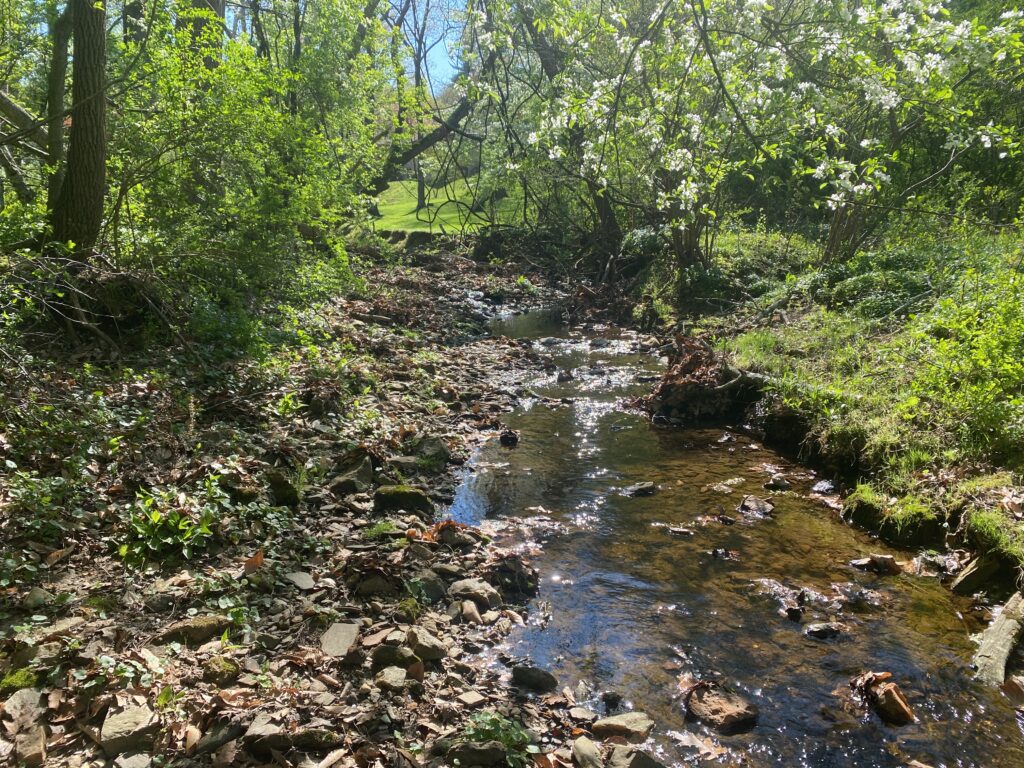
The first telltale signs of beaver (Castor canadensis) activity at Ashbridge Preserve, found in late October, were chewed branches and a suspicious build up of twigs, branches, and other woody debris in Ridley Creek. Soon after, Watershed Program staff noted a slow, but steady, increase in the water depth in the riparian restoration area which could only mean one thing: the beavers had arrived in Ashbridge Preserve! Over the course of the next several months, beaver constructed four dams within Ashbridge Preserve, raising water levels throughout Ridley Creek.

The largest dam, visible upstream from [1] the stepping stone crossing, was the perfect candidate to place a game camera to watch the construction process. Almost immediately, the cameras picked up footage of a single large beaver, working tirelessly each night to build and repair the dam. Within the first several weeks, a second smaller beaver joined in the effort, carrying small twigs and branches, gently patting mud and leaves into the construction project, and generally getting in the way as all children do while learning how to help their parents. They worked together most nights to create a system of dams that have had a big impact on Ridley Creek during the driest fall in Pennsylvania history.

At the beginning of October, water depth in the riparian restoration area in Ashbridge Preserve had fallen to the lowest levels recorded on the EnviroDIY Sensor. No rain fell during the month of October, yet the EnviroDIY Sensor recorded a four-fold increase in water depth as a result of the construction of beaver dams in downstream sections of the creek (figure 1). A beaver’s dam building behavior can completely change an ecosystem: flooding forests, creating ponds, irrigating desiccated soils, and bringing life with each trickle of water. Beaver ponds that form upstream of a dam slow the rate of flowing water and flood the surrounding watershed area. This allows moisture to permeate more soil as the water level rises. As semi-aquatic herbivores, beavers live both on land and in water, and the engineering of higher water levels through the construction of dams provide easier access to food and less risk of predation, especially for young family groups. In periods of drought, like that which impacted the region in October, the increasing water level provides essential hydration for thirsty plant roots while also creating important refuges for aquatic and terrestrial wildlife alike.

Where beavers are active on the landscape, there is an increase in ecosystem biodiversity, wildlife abundance, and improved water quality. When beavers build dams, the ponding leads to more water entering the subterranean aquifer, which provides a critical resource during periods of low rainfall. Increased water retention supports environmental resilience, with hydrated soils and vegetation being more resistant to wildfires, storms, and erosion, and providing a safe haven for wildlife. While there is no guarantee that the family of beavers who called Ashbridge Preserve home this past winter will stay through the spring, the impact that they have had on the watershed will be long lasting.

Figure 1. EnviroDIY Sensor Station water depth in Ridley Creek from September to December 2024. The blue line demonstrates the impact of beaver dam construction in Ridley Creek at Ashbridge Preserve. The black line shows water depth in Ridley Creek during the same period where beavers are not present. Water depth at Ashbridge Preserve increased from 106 mm to 402 mm while the downstream site logged no increase. Spikes in water depth are from small rainstorms during this period.

Filed Under: Uncategorized

Transforming a Community

May 16, 2025 By Mike Cranney

How WCT is working with a local Homeowners Association to create habitat, improve water quality, and transform open space for an entire community

By: Mike Cranney, Director of Stewardship

In the summer of 2022, WCT’s Stewardship team first met with members of the Inverary community in nearby Villanova. A group of neighbors had reached out to discuss how they could improve some of their open-space areas, which at the time were largely being maintained as mowed turf. They had visions of community-wide access and trails, but walking around vast swaths of lawn was not very appealing, and the environmental and financial detriment of maintaining so much turf grass was glaring. Their HOA Council had decided that a change was needed, and a partnership with WCT presented an excellent opportunity for both organizations.

At the time of the initial meeting, WCT had recently applied for a new grant project through Pennsylvania’s Department of Conservation and Natural Resources (DCNR) that would provide funding for the cost of converting lawns to native meadow. After offering this approach to Inverary, everyone agreed that it was the perfect solution. For the next ten months, WCT worked with Inverary’s Landscape Committee to convey the plan to the entire community and make sure that everyone was on board. Through collaborative planning meetings, internal discussions by Inverary, public presentations, and plenty of feedback, the Council and the residents agreed to move forward.

Two key areas at Inverary were identified for the lawn to meadow conversion: the first, a roughly 6-acre field on the west end of the property; and the second, a 3.5-acre area to the east around a pond and associated stream. After a year and a half of planning and prep work, the meadow areas were finally seeded in the spring of 2024. The native seed mix comprised almost 30 different species, including asters, goldenrods, milkweed, coneflowers, and grasses. While meadows typically take 2-3 years to establish and flourish, the change was apparent as soon as that summer. The newly sown fields lit up with yellow and green, covered with black-eyed Susan and early germinating rosettes preparing to erupt in the coming years.

While the meadow planting was a success, due to grant restrictions it still left roughly a 50-foot gap between the newly seeded areas and the edge of the nearby waterways. This is where the WCT Watershed team stepped in and began planning for phase two of the project: a tree planting that would surround the pond and stream. Working with yet another grant from DCNR, this one for planting in non-vegetated streamside areas, a proposal was devised to buffer the space with native trees and shrubs. This process was again only made possible through a collaboration with Inverary to make sure that all of the residents understood and supported the project. After a few meetings and discussions with the neighbors on site, phase two was ready to go.

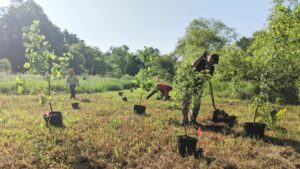
In October 2024, WCT staff returned to Inverary, and with the help of volunteers, students, and residents, planted more than 400 trees and shrubs over the course of four days. Members of the community, as well as their landscaping staff, were able to learn about the value of the project and how to best manage the site while helping to dig holes, install deer protection cages, and water in the new residents. Despite the prolonged drought that followed, the plants have held up well, thanks in large part to the effort of WCT staff and Inverary volunteers who came back twice a week for a month to haul and dump buckets of water. These trees and shrubs now have a happy home where they can grow and thrive. Without the overwhelming support and enthusiasm of the Inverary community, this entire project would not be possible. It is an inspiring effort that not only benefits the environment, but also brings people closer both to the natural world and to one another. This spring, 2 more acres of meadow will be planted at Inverary, creating sites that will provide a beautiful entryway into the community and expand on the initial work to build a more attractive and accessible connection between the other restored areas. It is evident from the number of inquiries that WCT has received since its implementation that the success of this project is already influencing other communities, and undoubtedly will continue to do so for years to come.

Filed Under: Uncategorized

Rushton Farm: A Recipe for Change

May 16, 2025 By Molly Clark

By: Molly Clark

As the Rushton Farm staff prepares for the farm’s 18th season, it is an opportune time to reflect on the significance of the farm and its value as a model for bringing conservationists and agriculture together. The progressively dire news about climate change and environmental degradation continues to be disheartening and reasons for hope can be elusive. Reports about the impact of the industrial food system are equally grim. Industrial agriculture relies on larger and larger tracts of monocultures stewarded by fewer farmers. It is characterized by increased dependence on petroleum-based chemicals and a complete disregard for the living resources on which the production ultimately depends. The food produced is overprocessed and less safe. For example, according to the Environmental Working Group, in 2024, residues of 254 different pesticides and pesticide residuals were found on 75% of the conventional produce tested by the United States Department of Agriculture and the Food and Drug Administration.

This summation is discouraging. However, agriculture- done right- can be a source of hope. Food provides a joyful way to take action in small but consequential ways. The connection between the food we eat and the environmental changes we want to see is so important and often overlooked. Wendell Berry, essayist, environmental activist, and farmer, summarized this crucial connection, writing:

“If conservationists merely eat whatever the supermarket provides and the government  allows, they are giving economic support to all-out industrial food production; to animal factories; to the depletion of soils, rivers, and aquifers; to crop monocultures and the consequent losses of biological and genetic diversity; to the pollution, toxicity, and overmedication that are the inevitable accompaniments of all-out industrial food production…” (“Bringing it to the Table”, 2009)

In the case of Rushton Farm, a community of conservationists were instead willing to insist on setting a better example. Starting a community-supported organic farm on land that is permanently protected was such a prescient idea and in the years since its formation, the farm staff has endeavored to ensure the replicability of the model.

Purposefully locating this farm on a nature preserve to demonstrate the way land can be used productively while benefiting the surrounding ecosystem continues to be impactful. As a community, we must continue to amplify and prioritize the connection between the food we eat and the land and living resources required to grow it.

So What Can We Do?

Two simple words: eat responsibly. The reality is, of course, more complicated. Our food chains are long and complex and the sheer number of bewildering packaging labels in grocery stores can make it hard to support environmentally and socially responsible producers. An organization called A Greener World recently published a guide that is intended to help consumers decipher these food labels (“Food Labels Exposed”). The guide requires ten pages to detail information such as which labels are backed by certification processes and which are just marketing hype.

However, three decades ago, Wendell Berry offered more digestible advice in his essay “The Pleasures of Eating”. He encouraged consumers to:

  • Participate in food production.
  • Prepare your own food.
  • Learn the origins of the food you buy.
  • Whenever possible, buy from local producers (local food systems are easier to understand and influence).
  • In self-defense, learn as much as you can about industrial food production and its impacts on personal health and the health of the planet.
  • Learn what is involved in better farming practices.

Rushton Farm in Action

Much of what we do at Rushton aligns with Berry’s timeless advice. Our Community Supported Agriculture (CSA) members are participating in food production by directly supporting the farm. Our members know exactly where a substantial portion of their food comes from. They pick up their weekly shares right at the farm and can see and ask us about our production methods while enjoying the natural beauty of the farm and nature preserve.

We encourage and facilitate home gardening through our terrific plant sale the first weekend in May. We know that growing just one basil plant or a few lettuce starts at home can change perspectives on the value of good food.

Participating in a farm volunteer day is a great way to learn about organic farming and how to have success growing food at home. The farm crew appreciates the help and enjoys talking about all things food and farming while working together.

If members of the community need inspiration or want to learn more about preparing their own locally sourced food, they can check out the farm-to-table dinners offered at the Rushton Conservation Center and let us know what kind of food-related classes would be most constructive!

We also host school groups throughout the season, giving students the chance to tour the farm, learn more about agriculture, and help with farm work. We hope these experiences encourage the next generation to think more deeply about where their food comes from and the resources- both human and environmental- that go into producing it.

A Call for Action Growing, preparing, and sharing food is a joyful act. It is also an opportunity for meaningful action. Conservation-minded consumers with an appetite for change are essential to driving the transformation our food system desperately needs. By thinking critically about the origins of our food and the impact of our choices, we can help create a better future- one bite at a time.

Filed Under: Uncategorized

Beauty in the Brambles: A Primer for Seeing Your Wild Shrub Habitat in a New Light

May 16, 2025 By Blake Goll

By Blake Goll and Michelle Eshleman

As we thaw out after this chilly winter, you are probably itching to get started on your yard preparations. You’re digging out your weathered gardening gloves from a box in your closet, making lists of plants to incorporate into your flower beds, and preparing the soil to welcome new life. You may be envisioning the bright yellow of black-eyed Susan and the verdant green of fiddleheads that will replace the muted, neutral tones of winter. Beyond the changing color palette, consider the new vibrant soundscape of your yard. Perhaps you are looking forward to  hearing towhees encouraging you to “drink your tea!” and a robin singing “cheerily, cheerio!” in the morning light.

The diversity of this avian chorus directly reflects the habitat we have created or preserved on our properties. The more varied the habitat, the richer the soundscape. Interestingly, studies show this is directly related to our mental health as if we are hard-wired to not only appreciate, but to need biodiversity. One way you can boost diversity of plants and wildlife in your yard this spring is by learning to see the beauty in the brambles.

THE BEAUTY OF THE BRAMBLES? When we speak of the beauty in the brambles, we are referencing the early successional shrub habitat, dominated by shrubs, a few small trees (less than 20 feet tall), vines, grasses, and wildflowers. It’s the thicket at the edge of a woodlot where you see young birds darting around and learning how to forage, where your children find their first caterpillar snugly wrapped in a chrysalis or a bunny poking his head out from under a bush. Unfortunately, our neat and tidy aesthetic is at odds with Mother Nature’s love of “messy”. We must recognize the critical value that threatened shrub habitats hold for birds and wildlife.

SHRUB HABITAT IS DISAPPEARING. In the United States, we lose roughly 150 acres of natural land every hour. That’s the equivalent of losing more than the entirety of Shenandoah National Park every year (Land Trust Alliance). Since 1970, bird populations in the U.S. and Canada have declined by 29%, or almost 3 billion birds, signaling a widespread ecological crisis. The largest factor driving these declines is likely the widespread loss and degradation of habitat (Science, 2019). Early successional shrub habitats are particularly important for maintaining the diversity of native plants and animals. Unfortunately, they are one of the most endangered ecosystems in the United States, often being cleared for visual appeal. Since greater than 80% of land is privately managed in the lower 48 states (Narango, 2018), we have the power to change this trend.

SHRUBS ARE FOR BIRDS. Shrub habitats receive more sun exposure than mature forests. This makes them rich sources of wildlife forage: insects, fruits, seeds, berries, and nuts. As “nature’s pantry,” these open habitats provide year-round food and cover for mammals like deer, pollinating bees and butterflies, and a myriad of bird species from Brown Thrashers to Eastern Towhees. Shrub habitat boosts breeding bird populations even in small patches. Not only do typical shrubland dependent birds nest directly in the habitat, but even forest birds—like Ovenbirds and Wood Thrush—hone in on early successional havens after leaving their nests in the woods. Studies show that juvenile birds favor these brushy tangles over open woodlands because of the higher density of food and cover from predators during their vulnerable, formative months. In addition, many migratory birds use early successional shrub habitats as vital stopover sites during their strenuous migratory journeys. Others, like White-throated Sparrows, take advantage of the rich accessible food sources all winter long.

Embracing Messiness! A Tiered Approach to Supporting Shrub Habitat

1. Replace Invasive Shrubs with Natives in Phases | If you already have shrub habitat on your property, you can remove individual invasive plants or clear small, manageable patches at a time. Immediately fill the cleared space with native shrubs (closely spaced 4-6 feet on center) that have high value for wildlife (see QR code below). Phasing the project in this way preserves some habitat structure for wildlife while the new shrubs are maturing.

2. Plant and Protect New Native Shrubs | If you currently do not have shrub habitat and have an area of your lawn you don’t use, consider replacing the manicured lawn with native shrubs in well planted beds. Newly planted shrubs should be protected from deer with fencing for at least the first three years. Invasive plants and vines may need to be removed each year.

OR

3. Leave it Alone | The easiest method of all is simply leaving brushy areas be. It can be tempting to clear because of the stigma around messiness or invasives, but the disturbance caused by wholesale clearing only leads to recolonization by more aggressive invasives. If you are not committed to replacing removed invasives with natives, it’s better to leave things alone. The invasive plants still provide structural diversity and cover for birds. The next time you get the choice to embrace or eliminate shrub habitat, we hope you’ll consider the beauty in the brambles.

Filed Under: Uncategorized

WCT Receives “Protect Your Drinking Water” Grant

April 23, 2025 By Kate Etherington

By: Kate Etherington & Lauren McGrath

Willistown Conservation Trust (WCT) is thrilled to announce that our Watershed Protection Program has been awarded a $10,000 grant from Aqua Pennsylvania and the Pennsylvania Environmental Council (PEC). At a ceremony held on April 18, 2025, Executive Director Kate Etherington and Director of Watershed Protection Lauren McGrath proudly accepted the award, which will fuel the next phase of our critical work safeguarding the health of our local waterways — and, ultimately, the water you drink.

Since 2017, WCT’s Watershed Protection Program has made significant strides in understanding how land conservation directly impacts the health of small-order streams. Through rigorous, long-term monitoring, our team has gathered a wealth of data illustrating the powerful connection between human activity and water quality. These insights culminated in the 2022 publication of The State of Our Streams — a landmark report that drew on expertise across WCT’s Watershed, Bird Conservation, Agroecology, Land Protection, and Stewardship departments to reveal the intricate web linking land use, wildlife, and water health.

This new grant funding will enable WCT to publish a second edition of The State of Our Streams, incorporating three additional years of water chemistry data along with new findings from benthic macroinvertebrate surveys conducted between 2018 and 2023. Benthic macroinvertebrates — small, spineless creatures visible to the naked eye — play a vital role in freshwater ecosystems and are key indicators of stream health. Their presence (or absence) can tell us a great deal about the overall condition of our watersheds.

In addition to the macroinvertebrate analysis, the updated report will feature expanded chapters on sensitive wildlife species recently documented in our local streams, including freshwater mussels (Unionidae), river otters (Lontra canadensis), American mink (Neogale vision), and American beavers (Castor canadensis).

We are deeply grateful to Aqua PA and PEC for their continued partnership and support, and we are honored to stand alongside the other six grantee organizations working tirelessly to protect and restore the waters that sustain both people and wildlife. You can learn more about the grant and other grantee projects here.

Filed Under: Uncategorized

  • « Previous Page
  • 1
  • 2
  • 3
  • 4
  • 5
  • 6
  • …
  • 17
  • Next Page »

CONTACT

925 Providence Road
Newtown Square, PA 19073
(610) 353-2562
land@wctrust.org

501(c)(3) EIN 23-2841453

JOIN OUR MAILING LIST

Copyright © 2026 · WCTRUST.ORG