WILLISTOWN CONSERVATION TRUST

  • Facebook
  • Instagram
  • LinkedIn
  • YouTube
DONATE
  • About
    • HOW WE WORK
    • WHERE WE WORK
    • OUR STAFF AND TRUSTEES
    • JOBS & INTERNSHIPS
    • RUSHTON CONSERVATION CENTER
    • STRATEGIC PLAN
    • INCLUSION, ACCESS, AND BELONGING
    • FAQs
  • LATEST
    • BLOG
    • IN THE NEWS
    • PUBLICATIONS
    • PHOTOS
  • EDUCATION
    • GROUP EDUCATION
    • LAND PROTECTION
    • STEWARDSHIP
    • BIRD CONSERVATION
    • COMMUNITY FARM
    • WATERSHED PROTECTION
    • RUSHTON NATURE KEEPERS (RNK)
  • NATURE PRESERVES
    • ASHBRIDGE PRESERVE
    • HARTMAN MEADOW
    • KESTREL HILL PRESERVE
    • KIRKWOOD PRESERVE
    • RUSHTON WOODS PRESERVE
  • EVENTS
    • EVENT CALENDAR
    • BARNS & BBQ
    • RUN-A-MUCK
    • WILDFLOWER WEEK
    • ACCESS Program
  • Support
    • WAYS TO GIVE
    • SPONSOR THE TRUST
    • CORPORATE PARTNERSHIP PROGRAM
    • JOIN THE SYCAMORE SOCIETY
    • LEGACY SOCIETY & PLANNED GIVING
    • VOLUNTEER
    • DELCO GIVES 2026

Water You Waiting For? Dive into Macroinvertebrates and Stream Health

April 29, 2024 By Watershed Protection Team

By Sally Ehlers, 2023 Watershed Protection Program Co-op

For over a century, macroinvertebrates have been our partners in understanding the intricacies of stream health, providing us with valuable insights that shape the conservation efforts of our aquatic ecosystems.

Macroinvertebrates are small organisms lacking a backbone that are visible to the naked eye, which inhabit aquatic environments. They form a diverse and abundant group, but their significance extends beyond mere existence – they are crucial to ecosystem function. By converting organic plant matter into animal biomass, these tiny marvels create a foundation that supports the intricate web of life in our streams and lakes. The diet of larval amphibians, fish, other aquatic insects, and birds are all supported by macroinvertebrates.

Macroinvertebrates are also reliable indicators of environmental health in our streams and lakes. Their presence – or absence – illustrates the overall well-being of these water bodies, making them an asset in bioassessments. Their widespread distribution, sensitivity to changes in water quality, and diverse abilities to tolerate environmental stress make them indispensable tools for monitoring and maintaining the health of aquatic ecosystems. These remarkable organisms help us learn about what is happening in our waterways.

Certain taxa (insect groups) are known to be sensitive to environmental changes and are considered pollution-intolerant. Mayflies are known for their short adult lifespan and are highly sensitive to pollution, making their presence a highly valuable indicator of pristine or recovering water systems. Stoneflies are also sensitive to water quality, especially oxygen levels. Therefore, they are typically found in clear, well-oxygenated streams. Caddisflies are known for their case-making larvae and can tolerate a range of water quality conditions, but some species within this group are also sensitive to pollution.
In addition to these sensitive insects, there exists a cast of pollution-tolerant taxa in these freshwater environments. Some examples that are found in local waterways are midges, worms, and black flies. While not standalone indicators of water quality, their presence and abundance, paired with pollution-sensitive taxa, contribute to a more comprehensive picture of the ecological health of aquatic systems.

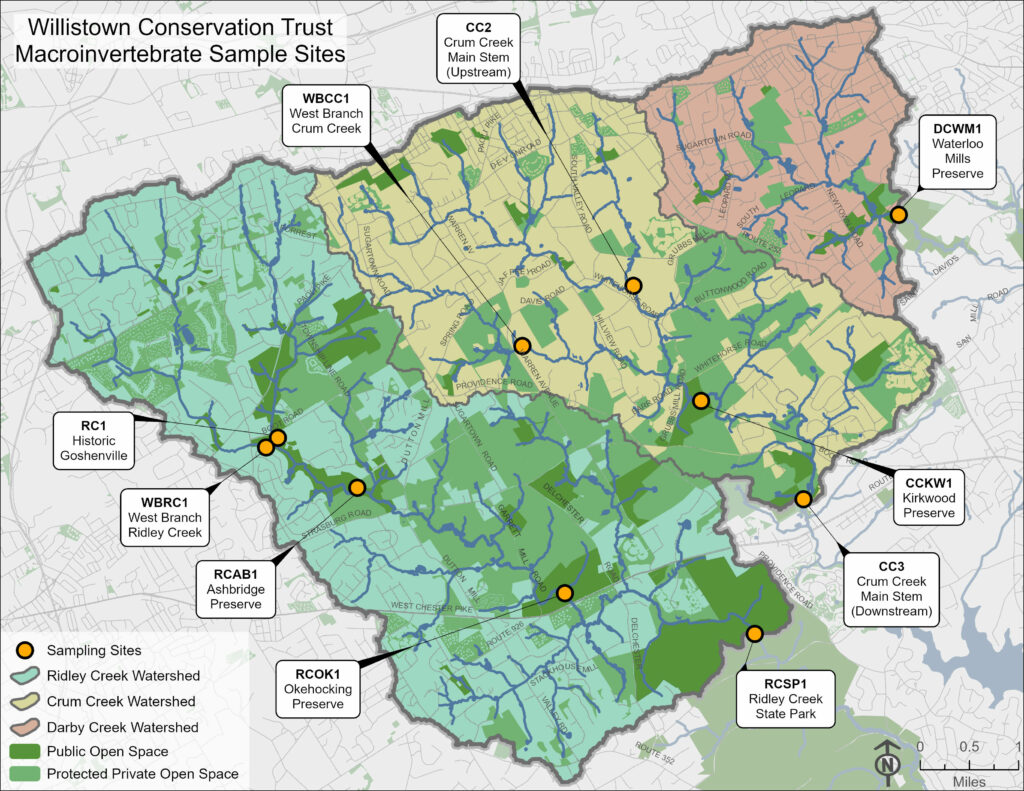
Each spring, the Watershed Team heads out to ten sites in Ridley, Crum, and Darby Creeks to collect macroinvertebrate samples using a Surber sampler (a modified net for collecting insects), a scrub brush, and lots of hard work (Map 1). Since these critters hang out at the stream’s bottom, we scrub rocks, letting the stream flow guide the macroinvertebrates into the net. As a Watershed Protection Program Co-op, I had an amazing time assisting with the 2023 sample collection.

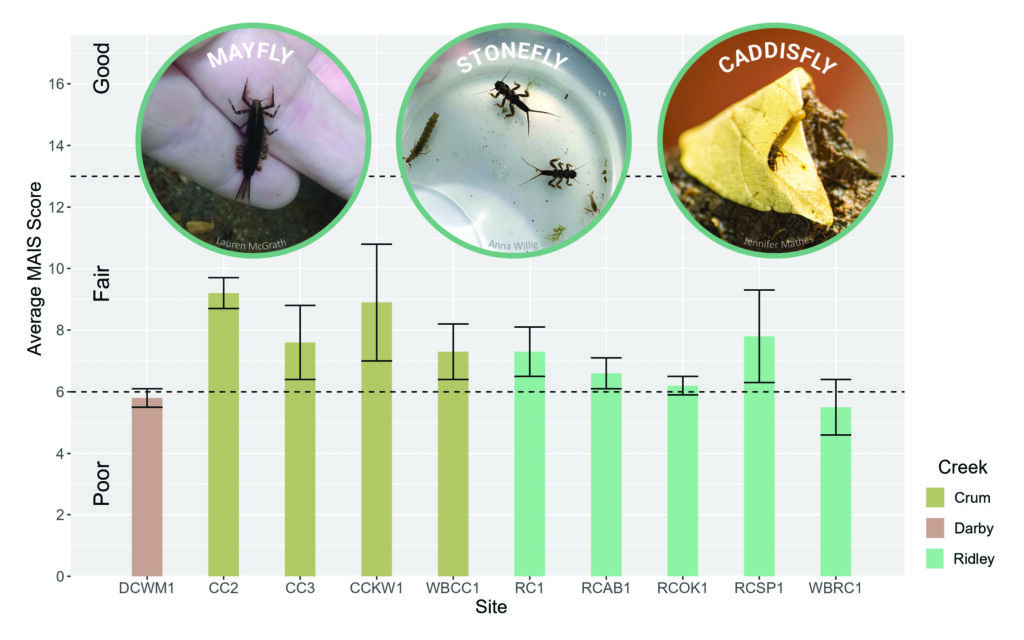
Now, my capstone project involves analyzing the data from past years to turn raw survey data into meaningful results. Macroinvertebrate Aggregated Index for Streams (MAIS) scores were calculated which combine several types of data into a single score that is used to classify stream health as “Good,” “Fair,” or “Poor.” Results suggest that on average, most sites are moderately impacted, with “Fair” health (Figure 1). However, DCWM1 (Darby Creek) and WBRC1 (West Branch Ridley Creek) had low MAIS scores, suggesting that these sites are in “Poor” health.

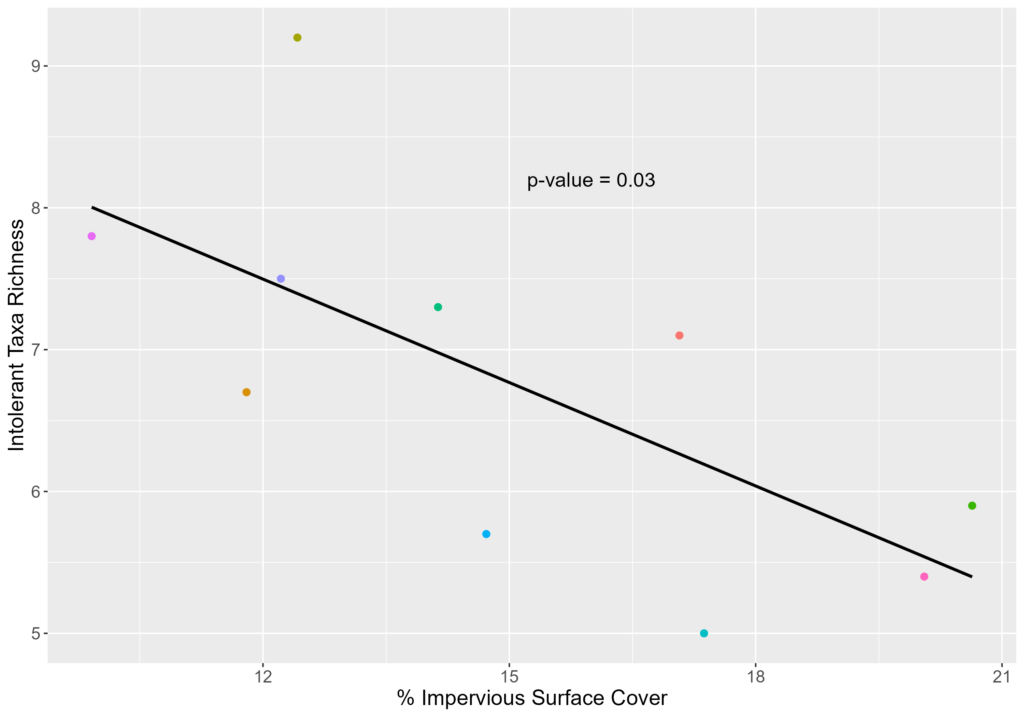
Development on the landscape helps explain why DCWM1 and WBRC1 rank lower in MAIS scores as these sites have 20% impervious surface coverage, the most out of all sample sites. Impervious surface cover refers to structures that are water-resistant such as paved roads, parking lots, and buildings’ roofs. Water cannot penetrate these surfaces and flows directly into waterways, picking up contaminants as it travels. In contrast, forested land allows water to seep into the ground and trees can help reduce the amount of runoff into the stream.

There is a significant negative correlation between percent impervious surface cover and intolerant taxa richness (Figure 2). This means that as impervious surface cover increases with more development, the number of pollution-sensitive macroinvertebrates decreases. Increased impervious surface cover leads to more runoff and contaminants, such as road salts, entering our waterways, and only macroinvertebrates that can withstand these changes can survive. This preliminary data highlights the importance of WCT’s land conservation efforts. Protected open space is critical to keep local streams healthy and macroinvertebrates thriving.

While it will take more sampling years to spot clear trends over time in local streams, the current data from 2018 to 2022 begin to shed a light on the state of these streams from the viewpoint of our macroinvertebrate community, and so far, aligns with existing water chemistry data. Follow along on WCT’s blog to take a deep dive into the data set and learn more about the results of the ongoing macroinvertebrate research effort!
Sally Ehlers | Sally is a senior at Drexel University where she is majoring in Environmental Science with minors in Biology and Writing. Before joining the Watershed Protection Program, she spent six months working at the National Oceanic and Atmospheric Administration Fisheries Lab in Highlands, NJ. There, she assisted with two ecotoxicology projects, focusing on the early life stages of local riverine and estuarine fishes. As a Watershed Protection Program Co-op over this past spring & summer, she helped collect water samples, run water quality analyses in the lab, maintain equipment, and practice science communication through WCT’s blog and Instagram stories.

Filed Under: Uncategorized

Lessons from Rushton Farm

April 29, 2024 By Willistown Conservation Trust

By Andrew Wraith, Agroecology Project Coordinator

As an Environmental Studies student, you might have guessed that I’m a lover and keen observer of the natural world. I love looking closely and seeing what’s hiding in plain sight. It could be a beautiful little critter, a weird goopy-green fungus, or a tiny perennial flower that predates the tree canopy and gives clues to the history of a forest.

The natural world is full of lessons for those who take the time to pay attention and reflect on the eternal questions: What happened here, why, and what is this telling me? For example, the cool little critter might share an inspiring lesson on resourcefulness, and that green jelly fungus might teach us how to go with the flow. Every lesson is a treasure and an invitation to a deeper relationship with nature.

Rushton Farm is no different. We are working in a close relationship with nature. Here’s one of my favorite revelations from the past two seasons: the connection between farming and working with kids.

Experienced gardeners may be aware that it’s best not to take a seedling straight from the greenhouse grow mat and stick it out in the field to weather the elements. We don’t tell our kids once they can walk, “Now that you’re on your own two feet, it’s time you moved out and started supporting yourself”. The process we take our plants through at Rushton, from seeding to the field, closely mirrors children’s journey toward adulthood in our society.

It begins when we drop the seeds into the “seed flat” (an array of small wells in which we can plant up to 200 seeds at once). From there the seed flats go to rest on top of a heat mat, cozy and warm, and their journey begins. This is the “nursery” stage, a term used in both childcare and plant husbandry. As the seedlings emerge, they remain on the heat mat until they are ready to graduate to kindergarten, i.e., being taken off of the heat mats. In the greenhouse, they stay for a while learning elementary lessons, but mostly they’re busy growing up healthy. A full greenhouse is an exciting and high maintenance place to be. The needy seedlings require watering multiple times a day. Many plants require transplanting as they outgrow their old wear and prepare themselves for middle school. Those awkward tomato plants can be gangly, smelly, and pubescent at this stage.

Eventually, the day comes when they graduate to the high tunnel (the small greenhouse). Here they continue to be protected from the elements such as wind and rain, however, they are less insulated from the season’s changing temperatures, and learn to cope.

Right about the time when they start feeling like confident masters of their environment, they’re off to high school! High school for plants is outside of the greenhouse, where they finally feel the freedom of fresh air and direct sunlight, however, the transition can be tough as they learn to deal with the sometimes harsh weather and deer exposure. The plants can start to feel very antsy to get out of their seed flats, or transplanting pots and into the ground, where they can finally stretch out their roots. They can start looking a bit downtrodden, but before too long they’re on the move again and off to college!

It’s an exciting time when plants are going into the ground. To set them up well requires hard work! We take time to settle them in place and help them by setting up their dorm (placing metal hoops over the rows and insulating the plants with covers). The greenhouse can feel like a strange place as the season progresses, empty, yet full of memories. You hope that your seedlings are thriving, weathering the challenges, protected from groundhogs and deer, while being ready to help in times of need.

When the time comes to remove row covers it can feel like the plants are stepping out of a time machine – my how they grow up so fast! The farmers give them a few final weedings, and before you know it, they’re the ones supporting us and helping us grow.

At Rushton Farm, this successive process is referred to as “hardening off”. As with raising children, we expose the plants to greater pressures and freedoms resulting in strong plants. The majority of my professional experience has been working with kids and to my surprise I’ve found that many skills apply to both professions!


ANDREW WRAITH | Andrew has worked as an outdoor adventure camp counselor for over a decade, which sparked his passion for helping kids fall in love with the outdoors and the infinite adventure of natural experience. After graduating from Syracuse University with a Bachelor of Arts in Physics, Andrew headed west to pursue work as a hiking guide in the Santa Monica Mountains in addition to playing music in Los Angeles. He ultimately returned east and found his way back to working with kids in the outdoors at Germantown Friends School where he has served in many roles including Adventure Camp Director, After School Program team member, Environmental Action Club Leader, and Lower School Assistant teacher. He is a current graduate student in Environmental Studies at the University of Pennsylvania and is very excited to be joining the team at WCT.

Filed Under: Uncategorized

Birds as Barometers of Ecosystem Health Rushton Woods Banding Station Year in Review 2023

April 29, 2024 By Bird Conservation Team

By Alison Fetterman, Avian Conservation Biologist and Blake Goll, Education Programs Manager

Introduction | As field biologists living in a human dominated world where wildlife populations have plummeted by 70% in the past 50 years — and birds, in particular, by 30% — the more biodiversity we can record, the higher our hopes. It turns out, bird banders are not alone in this innate need for birds. A recent study by the German Center for Integrative Biodiversity Research shows that connection to nature, especially bird life, is directly linked to our sense of wellbeing. The study linked greater bird diversity to increased life satisfaction for more than 26,000 people; the people who lived near natural areas with a greater diversity of birds were significantly happier.

But birds do more than simply enrich our lives. They are the ultimate environmental bellwether whose population changes can underscore global and local issues ranging from climate change to habitat degradation. At Rushton Woods Preserve and Farm, we strive to model restored landscapes where both people and wildlife thrive. Over 30,000 pounds of chemical-free food is produced annually on just a few acres of regeneratively farmed land within an 86-acre nature preserve. A total of 19,921 birds of 104 species have been documented (through banding) using the Preserve since 2010 (Figure 1).

Figure 1. Total new birds from 2010-2023

Here, food and feathers exist in harmony; instead of dominating the land with sights set only on profit, the land is honored with our sights set on feeding the community while bolstering biodiversity and ecosystem health. Birds are free to use the farm to refuel during migration or even nest during breeding, and the farm, in turn, benefits from ecosystem services like pollination and pest control, thanks to the preservation of adjacent native meadows and shrublands. It is in these shrublands where we conduct our migration banding efforts at Rushton Woods Banding Station (RWBS).

SPRING MIGRATION | Aside from the first unseasonably warm week in April, it was largely a cold spring lacking in the southerly winds required to drive migratory birds north to their breeding grounds in a synchronous manner. We experienced our lowest migration capture in our station’s 14 year history: 237 total new birds. Many factors can affect capture including habitat change, global population declines, weather, and effort. Because we only band three days per week and spring migration is rapid (with birds racing to be the first back to the best breeding grounds), it is possible we missed some of the waves of birds moving through. Nonetheless, the data did show delays in spring migration with the highest season capture (49 new birds) occurring on May 9th, one of the latest peaks experienced at RWBS.

Nonetheless, the Northeast’s dazzling diversity of warblers is never more evident than in May when they’ve donned their nuptial plumages and put forth their unique and soulful notes into the collective spring orchestra. Our catch included the wide-eyed Canada Warbler with her bohemian necklace of onyx, the zebra striped Black-and-white Warbler, the calico streaked Cape May Warbler with his striking orange face, the Magnolia Warbler with his stunning black mask and bright yellow throat, and the steel blue cloaked Black-throated Blue Warbler. Few artists could fabricate such a kaleidoscope of patterns and colors.

Some birds return to us year after year, exemplifying the importance of protected habitat, like Rushton Woods Preserve, as places birds can count on for refueling, overwintering, or nesting. One White-throated Sparrow, for example, was originally banded at Rushton in 2021, caught again in spring of 2022, and again in April of 2023. This bird likely overwinters at Rushton each year before returning to its northern breeding grounds in New England or Canada.

Baltimore Orioles are the impresarios of our hedgerows, belting out their whistle songs from the treetops once they return in May. Last spring we captured an adult male that we had originally banded in 2018, making him at least 7 years old! Each spring, he dutifully returns to Rushton to breed after overwintering in similar habitat in the tropics — quite possibly that offered by shade grown coffee farms — relying on the diversity of canopy structure offered by regenerative agricultural practices.

SUMMER BREEDING | Summer is the time when our banders retreat to the coolness of Rushton Woods to study the breeding populations of birds in our woodland for a national effort called MAPS (Monitoring Avian Productivity and Survivorship).

After a low catch of birds in 2022, we were up to a nearly all time high in 2023 with 155 birds of 17 species. We caught a record number of Gray Catbird (59), Carolina Wren (6) and Red-eyed Vireo (7). The former is unexpected as vireos are common breeders of the canopy where we cannot place our nets.

Another tree-top dweller that surprised us last summer was an adult female Scarlet Tanager. As we banded this beautiful yellow bird, her scarlet-colored mate impatiently scolded us from an uncharacteristically low perch. Though we hear males singing each summer, we were unable to fully confirm breeding success until observing this female in hand with a full brood patch (indicating a nest with young). As a State Responsibility Species, Pennsylvania plays a significant role in sustaining the global security of Scarlet Tanagers by hosting 10% of their breeding population.

FALL MIGRATION | The fall procession of southbound neotropical migrants is slow and steady — with birds no bigger than a third of an ounce winging their way along ancient pathways stretching for hundreds of miles in the star studded dark of night. This goes on for almost a month longer than the hurried spring migration, creating multiple waves of species moving through (Figure 2). Like clockwork, as the radiance of the goldenrod fades and the leaves become one with the autumn wind, the bounty of bright warblers morphs into the more muted earth tones of sparrows and kinglets.

It was a relatively warm fall with the first week of September bringing an unprecedented heat wave during which temperatures soared dangerously high for safely operating mist nets. The health of the birds is our highest priority, so the station was closed for the entire week on account of heat for the first time ever. Once the season got underway, however, it turned out to be a successful one with the exception of a record low number of Ovenbirds (only one individual compared to our usual 15-30).

The catch included record high counts for Ruby-crowned Kinglet (113), Swamp Sparrow (33), Nashville Warbler (6), and Hermit Thrush (55). As one of the most intricate songsters of the bird world, the Hermit Thrush’s reedy tremolo echoes throughout woodlands of the mountains and the north. This shy bird is the hardiest of our brown thrushes and least dependent on tropical forests for wintering, often seen throughout the winter in our own PA backyards. For this reason, it is separated from the earlier migrating thrushes in the wave graph (Figure 2).

Figure 2. Representation of of species groups during fall migration | 2010-2023

Birders also help us document the species waves of migration. Last September, a local birder captured a spectacular sight: a Cape May Warbler feasting on cherry tomato juice at Rushton Farm! Most warblers primarily eat insects, but this striped sprite has a specialized, slightly decurved bill that allows it to also probe flowers and fruits for nectar; their long, curled tongues allow them to imbibe from ambrosias not available to other birds —from black cherry and tulip poplar flowers to grapes and tomatoes.

Back at the banding station, we had some rare captures last fall including a Mourning Warbler (only the fourth ever for our banding station) as well as our very first Orange-crowned Warbler in late October.
Orange-crowned Warblers are uncommon in the eastern United States during migration. As one might expect from the similarities of its fine, pointed bill to that of a Cape May Warbler, the Orange-crowned can also feed on nectar and sap, as well as berries and insects. In the west, they are known to dine from Red-naped Sapsucker wells! Its varied diet allows the boreal-nesting Orange-crowned to travel south later than other warblers.

The highest catch of the fall season occurred following a cold front on October 24th with a total of 126 birds of 17 species, including a Winter Wren. This magnificent little creature is a brown ball of plain, speckled feathers that has been gifted with one of the most stunningly spirited songs of the bird world — the ebullience of which has earned him the title of “heart of the forest.” Per unit weight, the Winter Wren actually delivers its song with ten times more power than a crowing rooster!

Last but not least, we ended the season with the first Fox Sparrow since 2017. Unmatched in elegance, the Fox Sparrow is a true bird of the north, nesting from Alaska east to northern Quebec and the Maritimes. Homeowners can provide suitable overwintering habitat for Fox Sparrows by creating or preserving thickets, early successional shrublands, and second-growth forest.

Conclusion | We do not take the temporary care of such wild beauty lightly, and it is the transient presence of these incredible trans-continental animals in our little preserve that casts a hushed reverence on banders as they begin their work in the mystical pre-dawn.

Bird banding is a powerful tool in bird conservation, allowing us to study species abundance and diversity, population patterns, survivorship, and productivity of migratory and breeding birds as well as ecosystem health. For a more in depth look to view Rushton Woods Banding Station (RWBS) Songbird Banding Report 2010-2023 click here.

Filed Under: Uncategorized

WCT Preserves Watson Easement

January 17, 2024 By Erik Hetzel

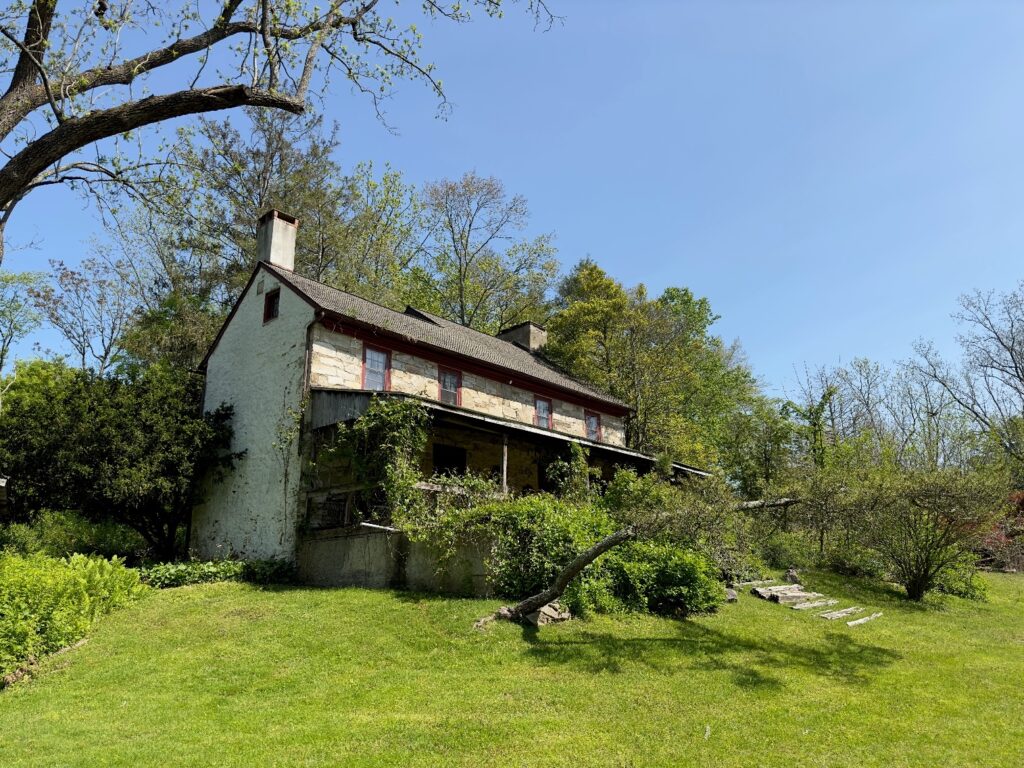
On December 5, 2023, WCT accepted its first-ever donation of a conservation easement on a property located in Radnor Township, Delaware County.  Thanks to the conservation vision of H. Ross Watson, his 5.6-acre property on Langdale Road known as “Frog Hollow” will be preserved for the benefit of its scenic, historic, and natural attributes and forever protected from further development.

In another first for WCT, this conservation project was accomplished in partnership with the Preservation Alliance for Greater Philadelphia, which concurrently accepted the donation of a preservation easement protecting the property’s historic buildings.  The Preservation Alliance notes that Mr. Watson’s 18th-century home and other buildings on the site “contribute to the historic sense of place and feeling of the property, and represent a valuable example of a historic architectural style worthy of preservation.”

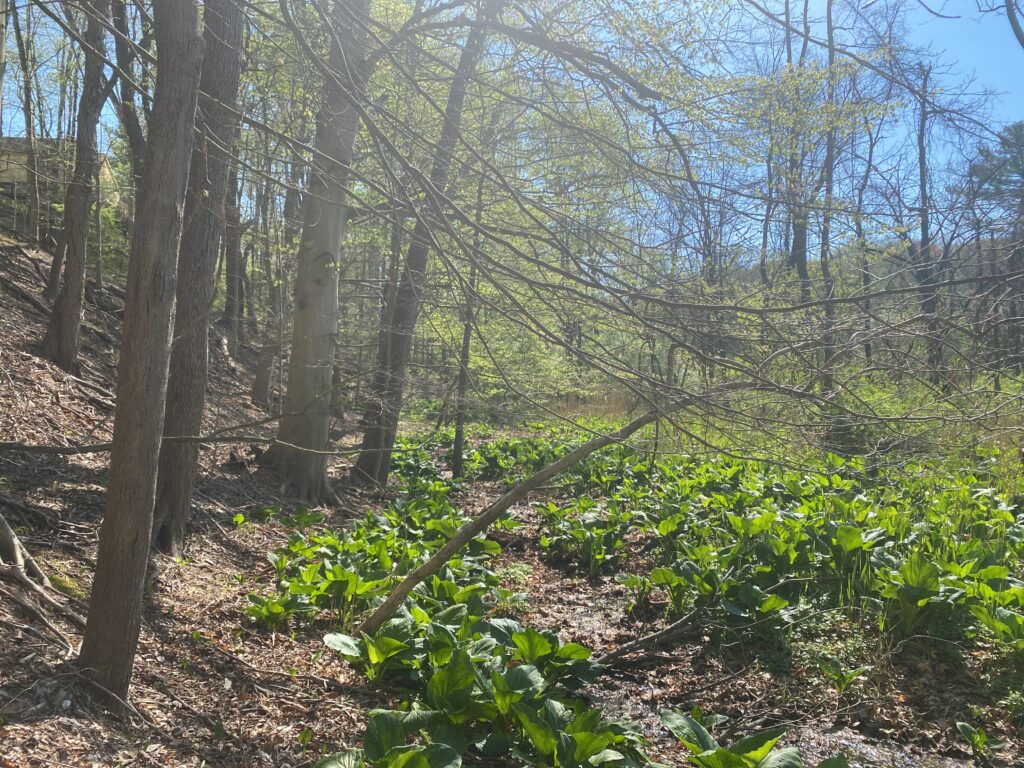
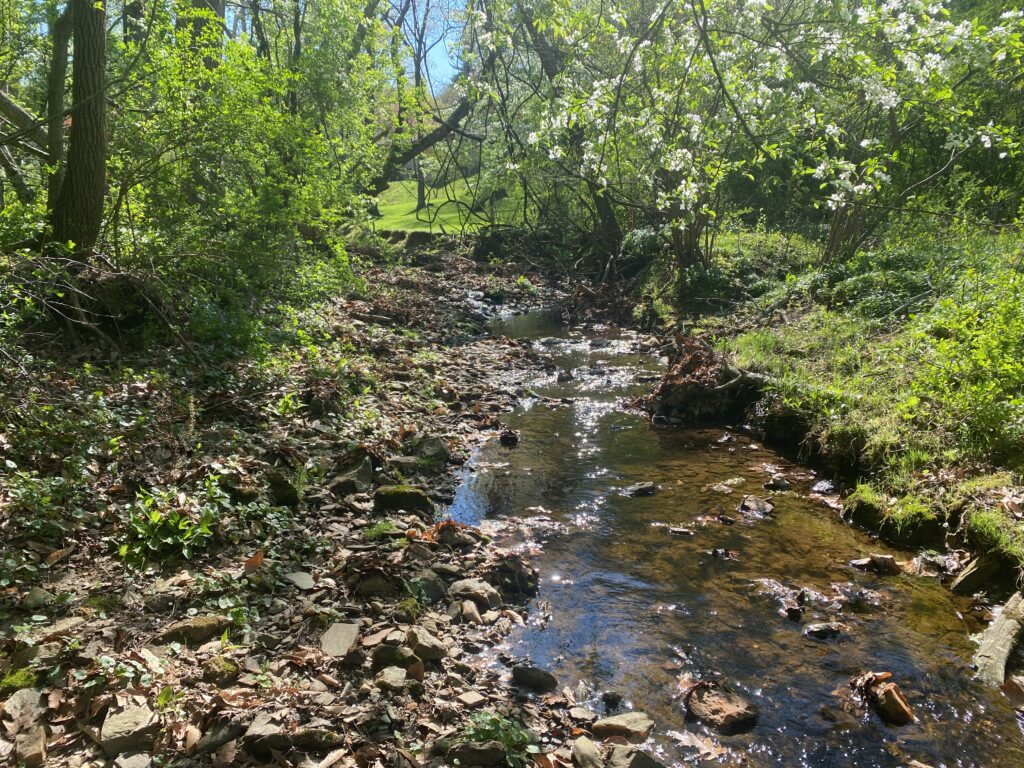
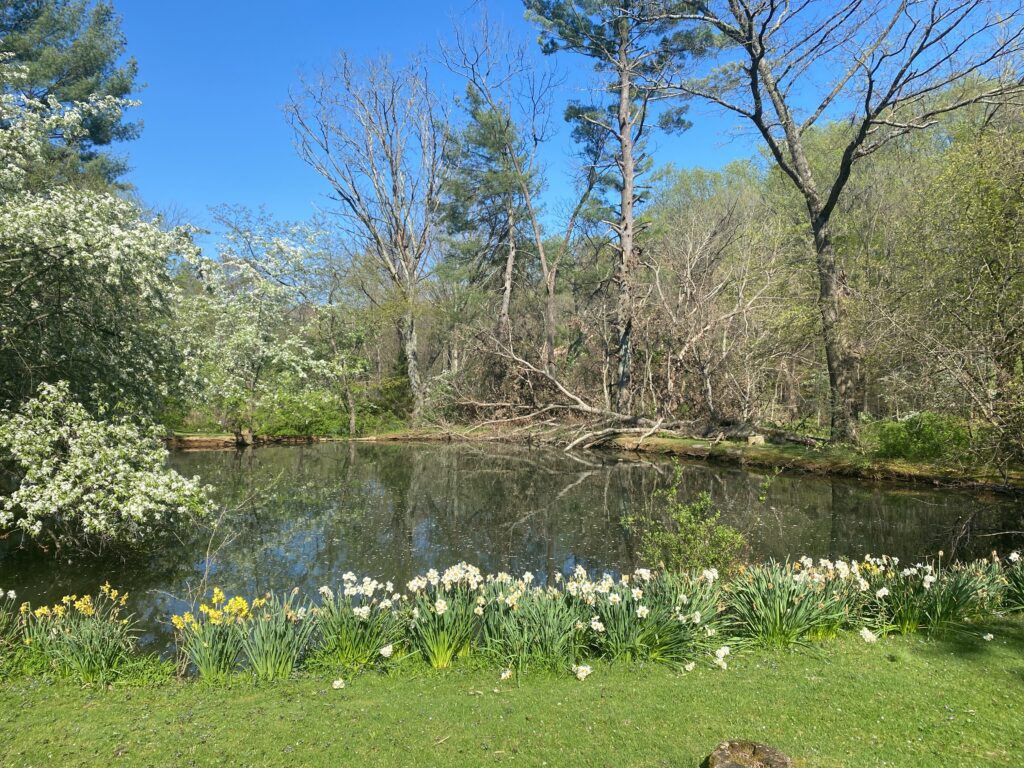
The conservation easement held by WCT will complement the work of the Preservation Alliance by protecting the property’s important ecological features and wildlife habitats, which include native and non-native non-invasive plant species, riparian resources associated with an unnamed tributary of Darby Creek, a spring-fed pond, wetlands, open grasslands, and steeply sloped woodlands.

The main dwelling on the property faces southeast toward the pond. The two story building was constructed in multiple phases, with the earliest being 1767.
Wetland vegetation marks the landscape transition to steeply sloped woodlands.
This unnamed tributary of Darby Creek is a prominent feature of the property.
The cold water spring-fed pond is home to an abundance of aquatic plants and wildlife.

Filed Under: Uncategorized

Ashbridge Tree Planting

January 3, 2024 By Anna Willig

The end of the year marks the end of the planting stage of the Ashbridge Tree Planting. Since 2019, generous funding from the Pennsylvania Department of Conservation and Natural Resources enabled us to plant nearly 1,500 trees and shrubs of 53 different species. What was just a few years ago an ecologically-barren swath of invasive grass is now an ecologically-rich habitat, supporting diverse pollinators, birds, and other wildlife, all while improving water quality in Ridley Creek. This project was made possible thanks to the help of dozens of staff, interns, board members, and volunteers, who spent hours digging, planting, watering, and weeding. While the planting stage is complete, the maintenance stage is just beginning. Stay tuned in 2024 for volunteer opportunities to help this planting thrive.

Filed Under: Uncategorized

  • « Previous Page
  • 1
  • …
  • 11
  • 12
  • 13
  • 14
  • 15
  • …
  • 19
  • Next Page »

CONTACT

925 Providence Road
Newtown Square, PA 19073
(610) 353-2562
land@wctrust.org

501(c)(3) EIN 23-2841453

JOIN OUR MAILING LIST

Copyright © 2026 · WCTRUST.ORG